Colour
Colour is the hardest thing to choose from a photograph, because a hand-knotted rug does not have one. The pile lies in a direction, so the same piece reads deep and saturated from one end of a room and pale and luminous from the other. Whichever end you are standing at when the rug arrives will be the colour you think you bought.
Why the colour changes as you walk
Every knot is cut so the fibre leans one way. Looking into the lean, you see the sides of the fibres and the colour reads dark and full; looking with it, you see the cut ends and the colour reads light. The effect is strongest on silk and clearly visible on good wool. It is worth deciding which direction faces the main approach to the room before the rug is laid.
Abrash, the bands that are not a fault
Hand-spun wool takes dye unevenly, and a dye lot runs out and is remade. Both show up as horizontal bands of slightly different tone, called abrash, running across the field. On a village or tribal rug it is normal and often the most attractive thing about the piece. On a fine workshop rug it is rarer, because the wool was spun and dyed in larger, more controlled lots.
The warm families
Red and burgundy is the classical Persian field and the colour most people picture when they picture a rug. Rust and orange sits beside it and reads warmer and less formal. Gold and yellow is uncommon as a field and frequent as a border, and brown carries the vegetable-dyed revivals such as the Chobi.
The cool and quiet families
Blue and navy is the other great classical field, and in a room with warm wood it does more work than red. Green is historically rare in Persian weaving and worth seeking out for that reason. Ivory and beige is the safest background and the least forgiving of traffic, and black and grey is largely a modern palette. Pink and rose is usually an aged red rather than a dyed pink.
Multi-colour, and what it is good for
Multi-colour fields hide more than any single-colour field: spills, wear paths, the line where a chair is always pushed back. In a dining room or a hall that is a practical argument, not a decorative one. An ivory field in the same position will show everything.
Light, and the room you actually have
North-facing rooms cool every colour down and will make a beige rug look grey. South light does the opposite and can push a soft red toward orange. If the colour matters, look at the rug in the room's own light before deciding, and remember that an older piece from the vintage band has already done most of its fading and will change very little from here.
-

4'5" x 6'7" 4'5" x 6'7" Persian Qum Rug | Charming Bird Garden | Ivory Fine Kork Wool | 2000's
Was: $7,130.00Now: $6,799.00 -

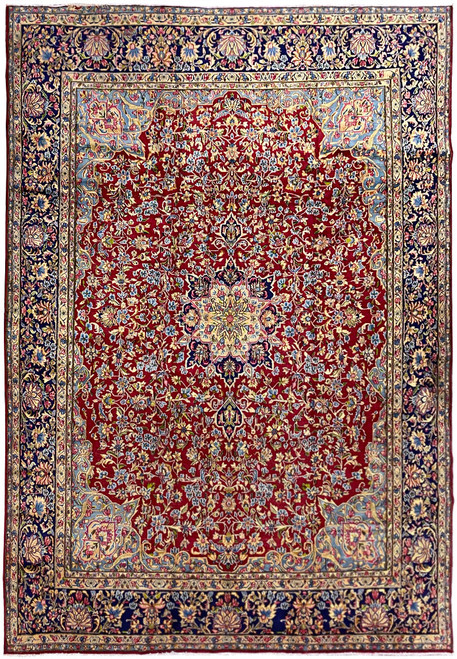
8'3" x 12' Persian Kashan Rug | Classic Ivory Lobed Medallion on Red Field | Vintage Style
Was: $3,140.00Now: $2,999.00 -
-
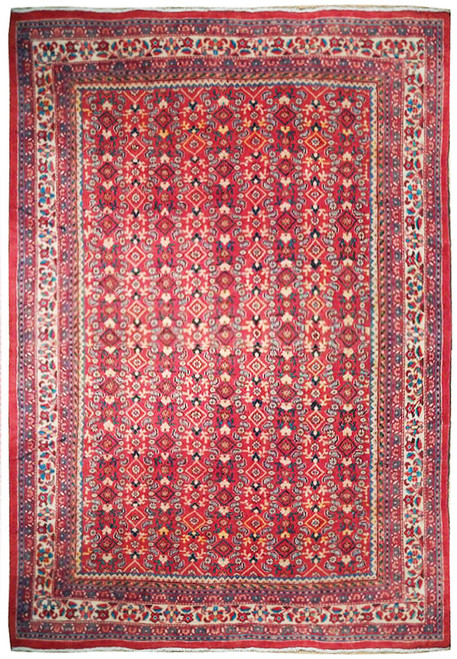
9'4" x 12'6" Persian Mahal Rug | Red Field | All-Over Herati Design | Diamond Compartments
Was: $3,640.00Now: $3,499.00 -

9'8" x 12'11" Kerman-Style Rug | Navy Blue Floral Medallion | Hand-Knotted Wool | Distressed Finish
Was: $3,700.00Now: $3,599.00 -

-

8'4" x 11'8" Persian Kashan Rug | Red Field, Ivory Medallion | Classic Workshop Floral Design
Was: $3,840.00Now: $3,450.00 -

-

-

9'8" x 12'10" Persian Mashad Rug | Opulent Berry Red & Navy Blue | Hand-Knotted Elegance
Was: $3,750.00Now: $3,200.00 -

5'9" x 8'9" Sino Tabriz Rug | Dramatic Black & Ivory | Fine Wool & Silk | Star Medallion
Was: $4,390.00Now: $4,120.00 -

9'8" x 12'8" 9'9" x 12'10" Persian Mashad Rug | Crimson Red Floral Elegance | Semi-Antique | Excellent Condition
Was: $3,350.00Now: $3,200.00