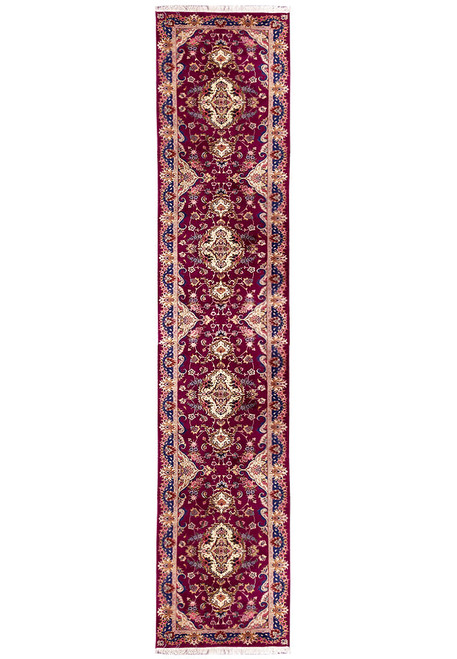
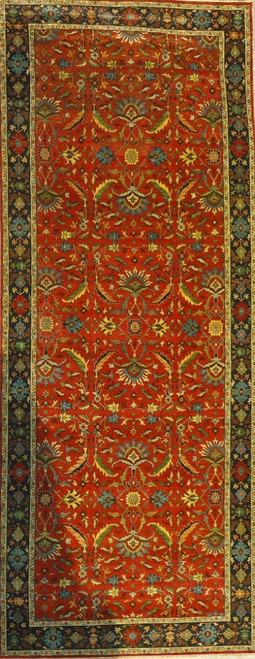
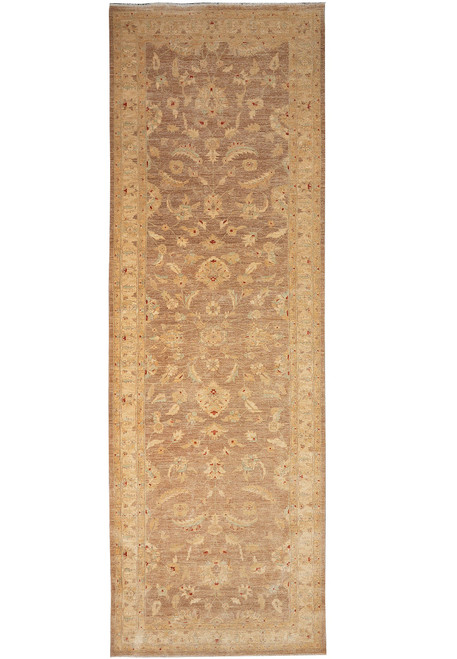
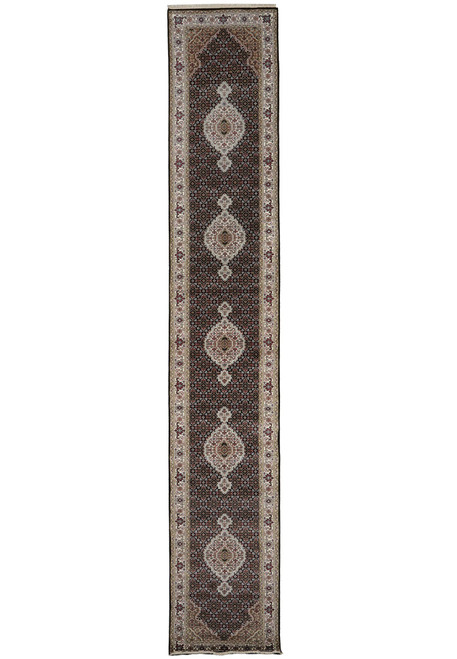
Runner Rugs
Runners exist because corridors do. The Persian trade calls them kenareh, the rugs that ran down the long sides of a reception room beside the broad rug at its head, and the format survived because narrow looms were cheap and every house has a passage in it. This is the one shape where the rug takes more punishment than any other in the building, and it should be bought accordingly.
The village loom and the narrow rug
A narrow loom is easy to build, easy to warp and can be worked by one person. That made runners the natural output of village weaving, and it is why Hamadan, whose name covers hundreds of villages weaving single-wefted rugs on simple looms, is the classic source. Senneh produced fine runners, Bijar produced heavy ones on a foundation that will survive being walked on for eighty years, and Bokhara and Afghan weaving supplies the repeating-gul runner that suits a long space better than a medallion ever could.
Measuring a corridor
Leave 3 to 5 inches of bare floor on each side. Less and the runner looks like fitted carpet that failed; more and it looks lost. For length, stop the runner short of the doorways at each end rather than running it up to the architrave, because an edge that sits in a doorway is an edge that gets kicked. If the corridor is longer than the runner, two shorter runners in line with a hand's width between them reads deliberately. One runner six inches short of the space reads as a mistake, every time.
Stairs, which are a separate job
A stair runner is measured tread by tread, riser by riser, plus an allowance for the nosing at each step, and the total is longer than people expect. Winders and turns need to be cut and pieced. It is fitted work with rods or staples and it should be done by someone who does stairs, not by the householder with a staple gun. Leaving extra length at the top so the runner can be shifted a few inches every few years is the single cheapest way of doubling its life.
What to buy, and what not to
Buy the densest, greasiest wool available and a design that repeats, since a runner is seen in sections and never all at once. Do not buy silk: it is strong in tension and weak against grit, and a hallway is nothing but grit. A flat, undrawn Gabbeh works in a modern passage, and Herati weaving supplies repeating patterns in the format. For short spaces an accent rug may be the better answer, and for the long narrow rugs that were woven as part of a room set rather than for a corridor, see rectangular rugs and the rest of the shapes.