Sarouk Rugs
Sarouk takes its name from a village near Arak in central Iran, but the rug most people picture under that name was designed for a foreign market. Detached sprays of flowers scattered across an open red ground, a thick heavy pile, a cotton foundation built to last. It is one of the few Persian types whose classic form was shaped by where it was going to be sold.
A village name that became a market
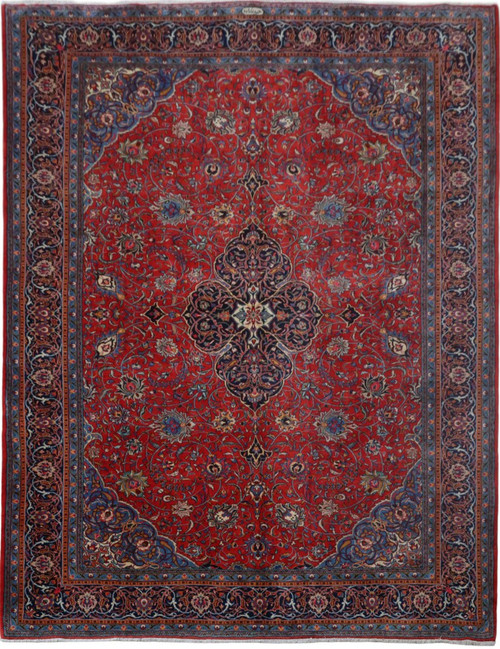
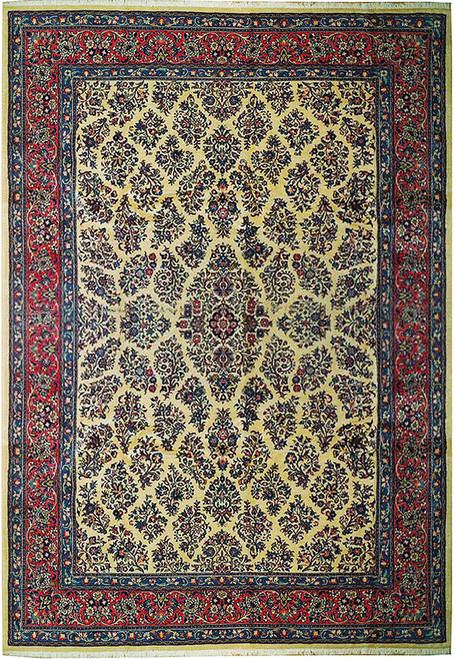
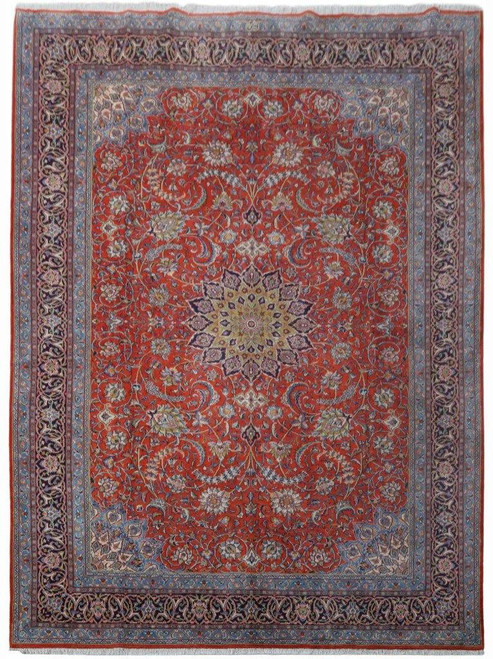
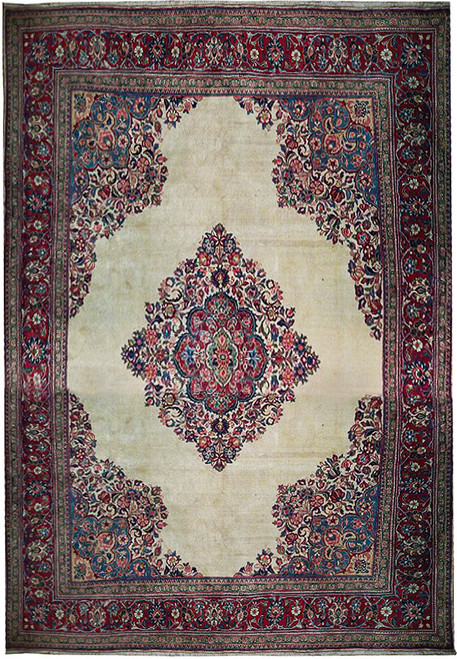
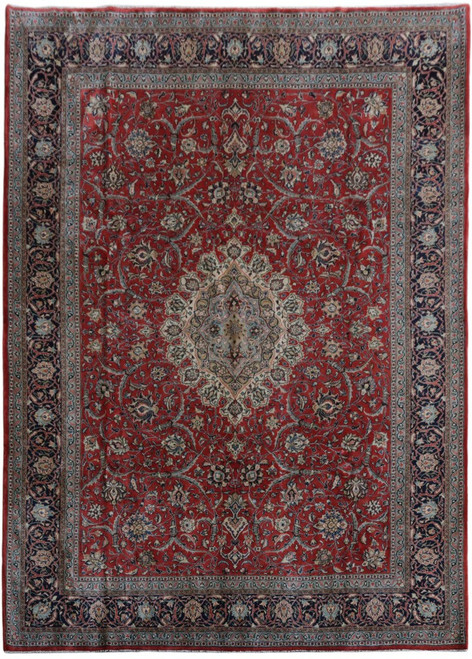
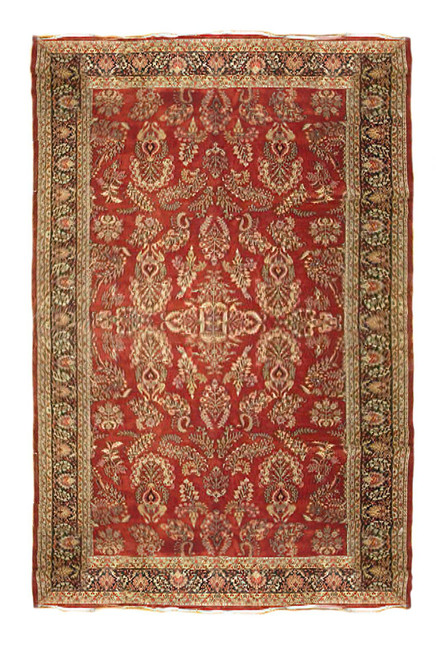
The village of Saruk lies in the weaving district around Arak, the town the carpet trade long called Sultanabad. Nineteenth century Sarouks were medallion carpets in the central Persian manner, and they are not what the name now brings to mind. From roughly the First World War until the Second, American importers bought the district's output in volume, and the design shifted to suit them. What emerged is the rug the trade still calls the American Sarouk: an open field, usually deep red, with detached floral sprays spaced across it and a border drawn to match. It is a repeating design without a repeat, and it was built to sit under furniture in a large room.
The detached spray
What makes the layout unusual in Persian weaving is the absence of connective tissue. Most Persian fields are held together by vine, so every palmette joins the next. The Sarouk spray floats. Each cluster of flowers and leaves is its own small drawing with plain ground around it, which is why the type reads as decoration rather than as a system. Put it beside a Kashan medallion or an all-over Herati field and the difference is immediate. The nearest relative in temperament is the large-scale, open Ziegler carpet from the same district, made for the same export reasons a generation earlier.
The painted Sarouk
This is the part worth knowing before buying. The natural field colour of many of these rugs was a salmon or raspberry pink that American dealers of the period did not want. The solution was to wash the rug chemically and then apply a darker red to the field by hand, brushed over the pile after weaving. The trade calls the result a painted Sarouk, and there are a great many of them. It was standard practice rather than a fraud, and it was done openly. It does leave a rug whose field colour sits on the surface instead of running through the fibre.
How to tell
Part the pile with your fingers and look at the base of the knot. On a painted rug the root is the original lighter tone and only the tip carries the applied colour. Worn areas go pale in patches rather than fading evenly, and the back often shows a shade that does not match the front. None of this makes the rug worthless, and many painted Sarouks have now lived a century. It does mean the field can bleed if it gets soaked, so wet cleaning belongs with someone who has met the problem before.
Built heavy
Underneath the design question, a Sarouk is a well-made rug. Cotton warp, cotton weft, the asymmetric knot, a dense pile left long, and wool from a region with good fleece. They are heavy for their size and they wear slowly. The related grades from the same district, Mahal and Mahajiran, describe coarser and intermediate weaving respectively and share the same construction. A pre-1970 Sarouk that has kept its pile is a genuinely robust floor covering, closer in durability to a Heriz than to any of the fine city weaves.
Rooms, and a warning about the field
The open ground is the type's strength and its weakness at once. It gives the flowers room to read, and it shows every path people walk. A Sarouk in a corridor will develop a visible lane long before an all-over pattern would, so it is better used where traffic spreads out: a dining room, a drawing room, a bedroom. It is a poor choice in a runner position for exactly that reason, even though runners were woven. The palette, deep red with rose, ivory and blue in the flowers, is warm and formal, and most surviving pieces sit in the six by nine to eight by ten range or larger. Among traditional designs it is the one that behaves most like wallpaper, which is meant as a compliment.