Semi-Antique Rugs (1970s to 2000s)
Semi-antique is the trade's name for rugs woven roughly between the 1970s and the 2000s. The boundaries are conventions rather than rules, and what they really describe is a rug that has had time to soften without having spent its pile: colours a step down from new, wool that has picked up a little polish, and most of its working life still in hand.
Twenty-five to fifty years, loosely
Nobody agreed this band in a committee. It exists because dealers needed a word for rugs plainly not new and plainly not old, and the dates drift with who is talking. Read it as a description of condition rather than a certificate: full or nearly full pile, colour that has come down a step, and a handle that has lost the stiffness of a rug fresh off the loom. The vintage band begins where the pile has genuinely worn down.
The band that gets skipped
Buyers tend to want either the oldest thing in the room or the newest, and this band falls between the two. It should not. A rug from the 1980s has done its shedding, its settling and much of its first shift of colour, and still has decades of pile to spend. Much of what came off the looms then is also worth having: Persian production continued throughout, and the workshops of India and Pakistan were building the vegetable-dyed revivals, the Ziegler and the Chobi, now woven everywhere.
The shortcut, and why it lives here
An afternoon in a chemical wash can take a rug's colour down several steps and put a sheen on the wool that otherwise takes twenty years. The trade calls the results an antique wash, a tea wash or a lime wash, and none of it is secret: some finishing wash is a normal last step in many workshops. It goes wrong in two ways. Aggressive washing leaves wool dry and brittle, and a washed rug described as an aged one is being described as something it is not. This band is where the two are hardest to separate, because a semi-antique is supposed to have full pile and softened colour, which is exactly what a wash produces.
Three checks that catch it
Turn the rug over. On a piece that has simply aged, the back is somewhat brighter than the face; where the gap is large and identical everywhere, suspect a wash. Then look for unevenness. Real light fading is uneven: the window side has moved further than the side under a sofa, while a wash moves everything at once. Last, handle the pile. Wool worked hard chemically feels dry and squeaky rather than faintly greasy. None of this makes a washed rug a bad rug. It makes it a new rug with a finish, worth reading as one.
Where they earn their keep
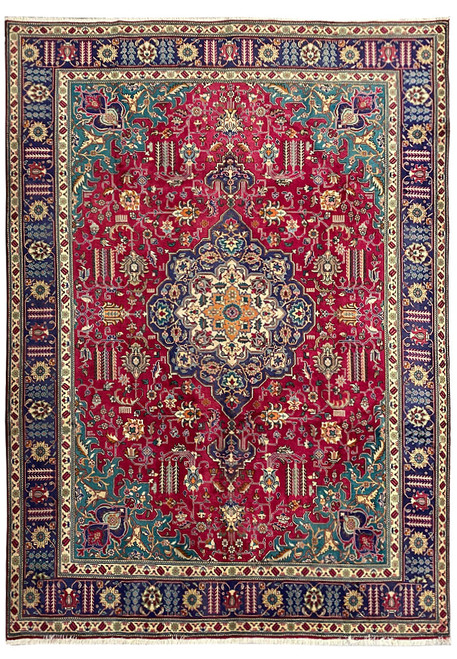
This is the practical band for rooms that get used: enough pile for a hall or a dining room, enough age that the first mark is not a tragedy. An Heriz or a Tabriz in wool from these decades will take a household. Fine city weaving of the same period, a Nain or something in wool and silk, wants a quieter floor. For colour that has finished moving, go to the pre-1970 end. For pile at full height, go to new. The bands are only legible against each other.
-

-

-

-

10' x 13' Semi-Antique Persian Mashad Rug | Rich Crimson Field & Ornate Floral Design
Was: $3,510.00Now: $3,200.00 -

-

4'5" x 6'7" 4'5" x 6'7" Persian Qum Rug | Charming Bird Garden | Ivory Fine Kork Wool | 2000's
Was: $7,130.00Now: $6,799.00 -
-
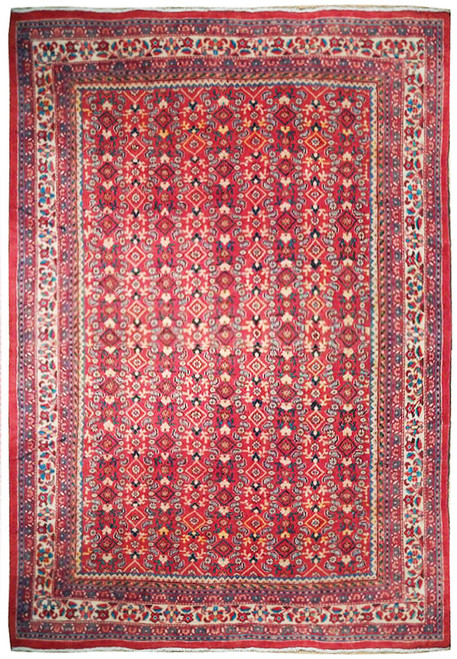
9'4" x 12'6" Persian Mahal Rug | Red Field | All-Over Herati Design | Diamond Compartments
Was: $3,640.00Now: $3,499.00 -

-

8'4" x 11'8" Persian Kashan Rug | Red Field, Ivory Medallion | Classic Workshop Floral Design
Was: $3,840.00Now: $3,450.00 -

9'8" x 12'10" Persian Mashad Rug | Opulent Berry Red & Navy Blue | Hand-Knotted Elegance
Was: $3,750.00Now: $3,200.00 -