Watch the film
| Size in ft: | Width: 10'2" x Length: 14'5" |
| Size in Inch: | Width: 122" x Length: 173" |
| Size in meters: | Length: 4.39 x Width: 3.10 m |
| Colors: | Red, Ivory, Navy Blue, Rose Pink |
| Shape: | Rectangular |
| Woven: | 100% Hand-knotted | Handmade |
| Foundation: | Cotton |
| Pile: | |
| Design: | Sarouk | Central Medallion | All-Over Floral |
| Origin: | Persian Sarough | Made in Persia |
| Condition: | Excellent | Ready for daily use |
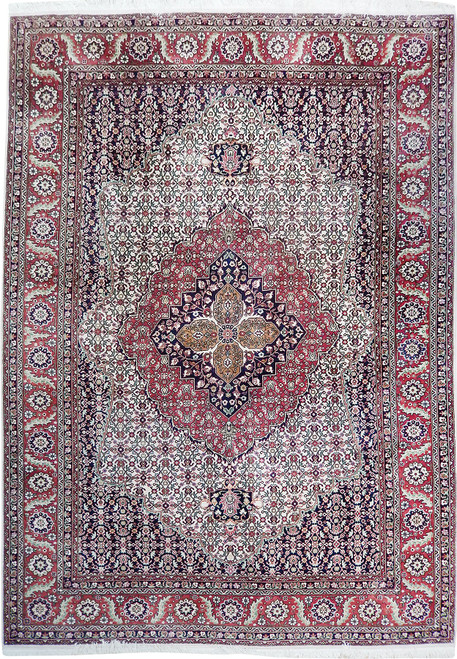
10'2" x 14'5" Persian Sarouk Rug | Red Field, Ivory Border | Semi Antique Oversize
This is a full room size Sarouk, 10'2" x 14'5", hand-knotted in wool on a cotton foundation with a close-clipped 3/8" pile that lets the drawing stay sharp. It follows the old formula for Persian Sarouk rugs: a deep red field carrying an all-over garden of curved vines, with a small ivory medallion set at the center rather than a heavy centerpiece that dominates the floor. The wool has the faint, even sheen that comes from years of settling, and the back photograph shows tight, regular knotting with no repairs or open areas in view. At this length it covers a 10 by 14 foot furniture plan comfortably, which puts it alongside our other 10x14 Persian rugs for dining and great room use. Every rug we ship travels with a certificate of authenticity recording origin, materials, size and knotting.
Design and Motifs
The center holds a lobed ivory medallion drawn in rose and navy, filled with an 8 petal rosette and finished top and bottom with small trefoil pendants. Around it the field runs as a continuous all-over scheme: long curving stems, serrated lancet leaves, split palmettes, rose sprays and small round rosettes, all mirrored across the long axis so the two halves answer each other. The 4 corners carry soft-edged spandrels in blue and ivory that echo the medallion without repeating it. The main border is an ivory ground with a meandering vine that links alternating palmettes and cypress-like floral clusters, and it is framed on both sides by narrow guard stripes in navy and red, with a fine reciprocal stripe at the outer edge and flat-woven ends. The scale of the drawing is generous, so the pattern reads clearly even with furniture sitting over parts of the field.
A Madder Red Field Framed in Ivory
The ground is a true madder red, warm and slightly brick-toned rather than orange, and it shifts a shade or two in the raking light of the corner photographs, which is the natural abrash of a wool pile dyed in small lots. Against it the ivory main border reads as clean cream with a faint honey cast, while the medallion and the rosettes bring in chalky white and a soft rose pink. Navy blue does the outlining work throughout, holding the leaves, palmettes and spandrels crisp, and a lighter sky blue fills flower centers and the occasional leaf so the field never goes flat. Smaller touches of pale gold, coffee brown and dark teal appear in individual blossoms, and the guard stripes drop to near-black navy for contrast at the edge. Overall the palette is classic red and ivory with cool blue accents, easy to place with dark wood, walnut, and warm neutral walls.
Sarouk Weaving in Central Persia
Sarouk is a weaving village in the Arak district of central Persia, and the name has stood for dependable room size rugs for well over a century. The village style is built for floors: a firm handle, a cotton warp and weft beaten down tight, and a short wool pile that resists crushing under chair legs and table feet. The wool from this region is springy and takes madder and indigo well, which is why old Sarouk reds keep their depth instead of turning dull. Weavers here work floral drawing borrowed from the court tradition but keep it slightly bolder and more open than an Isfahan or Nain would, a choice that suits a 14 foot rug seen from standing height. The weave visible on the reverse of this piece is even from end to end with a straight edge and no waisting, the mark of a well-managed loom and a rug that was made to be used rather than admired from a distance.
10'2" x 14'5" Persian Sarouk Rug | Red Field, Ivory Border | Semi Antique Oversize
Ask about this rug
This piece is the only one of it, so the things worth knowing about it are particular to it. If you want to talk through the size, the colour in your own light, or the weave, speak to someone here first.