Watch the film
| Size in ft: | Width: 10' x Length: 10' |
| Size in Inch: | Width: 120" x Length: 120" |
| Size in meters: | Length: 3.05 x Width: 3.05 m |
| Colors: | Ivory, Salmon, Brown, Green, Blue |
| Shape: | Square |
| Woven: | 100% Hand-knotted | Handmade |
| Foundation: | Cotton |
| Pile: | Wool with Silk Highlights |
| Age: | 2000's |
| Design: | Mahi Tabriz | Herati Fish | Central Star Medallion |
| Origin: | Persian Tabriz | Made in Persia |
| Condition: | Good | Pre-owned |
10' x 10' Square Persian Mahi Tabriz Rug | Herati Fish Field with Silk Highlights | Pre-Owned
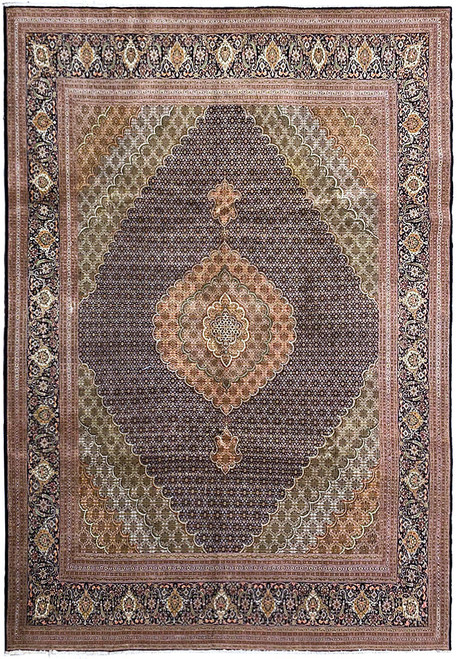
A true square is one of the hardest shapes to find in a handmade Persian rug, and this 10' x 10' Mahi Tabriz solves that problem outright. The ground is a dense ivory field worked in the miniature Herati repeat that Tabriz weavers call Mahi, with a rose and salmon medallion set at the center and soft blue-green corners closing the composition. The pile is wool carrying silk highlights that pick up light along the medallion outline and the scrolling vine, knotted on a cotton foundation in the 2000's. It is pre-owned and in good condition, with a low even pile and the crisp, disciplined drawing that marks workshop weaving rather than village work. Every rug we sell ships with a certificate of authenticity. If you have been hunting through square Persian rugs for a room a rectangle will never sit right in, this is the format that fixes it.
Please Note About the Photographs:
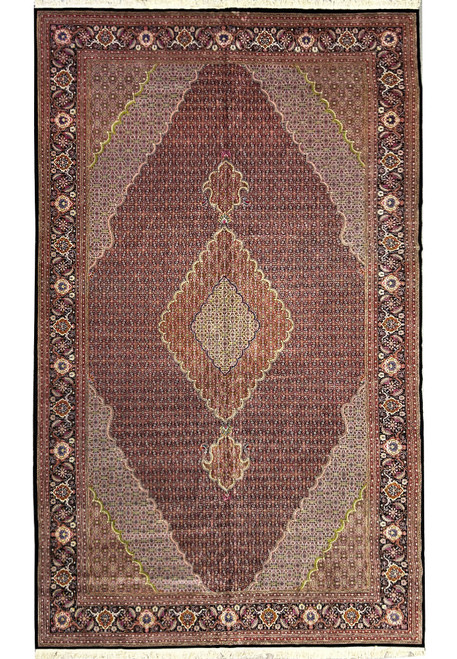
These pictures were taken on our warehouse floor from several angles under mixed daylight. The ivory field reads cooler and greener in the wide overhead shots and warmer in the close-ups, and the soft diagonal shading across the field is light and pile direction, not fade or damage. The medallion and border close-ups show the truest color. Every rug is professionally steamed and pressed before it leaves us.
Design and Motifs
The drawing is textbook Mahi, the fish pattern: a fine lattice of small diamonds, each holding a rosette flanked by two curved lanceolate leaves, the pair of leaves being the fish that gives the pattern its Persian name. It runs as an all over Herati design across the entire field, repeated thousands of times at a scale small enough that the surface reads as woven texture from standing height and only resolves into individual flowers when you crouch over it. At the center sits a serrated star medallion with an ivory outlined core, a salmon halo studded with dark rosettes and a lobed pendant reaching out at top and bottom. 4 corner spandrels answer the medallion in the same pale blue-green outline, each filled with the same micro herati. The main border carries alternating ivory cartouches and blue-green palmettes on a mauve-salmon ground, fenced in by narrow guard stripes of running vine and reciprocal trefoil.
Ivory, Salmon and Blue-Green Color Balance
The field ground is ivory, warmed toward cream and light wheat where the silk highlights sit. Against it, every herati diamond is outlined in deep navy and forest green, with rosette centers in brick, blush pink and pale yellow, so the overall field tone from a few feet away is a soft sandy taupe rather than flat white. The medallion breaks that calm with salmon and dusty rose, edged in a light seafoam blue-green that also traces the spandrels and the pendant tips. The borders move to cooler ground: a mauve and salmon main band holding ivory and teal palmettes, framed by guard stripes of seafoam, brown and ivory. Brown appears mostly as the shadow tone inside the vine work and along the outer edge. The result is a low contrast, tonal rug that stays quiet under furniture and reads warm in lamplight and cool in daylight.
Tabriz Weaving and the Mahi Tradition
Tabriz sits in northwest Persia and has been the commercial and technical capital of Persian weaving for centuries, the city that revived the court designs in the 19th century and still sets the standard for fine wool knotting. Its workshops measure fineness in Raj, the number of knots across a gereh of about 2.75 inches of warp, and the Mahi layout is the house pattern that separates a competent Tabriz loom from a merely decorative one, because the repeat only holds its geometry if the knot count is high enough to draw each tiny leaf cleanly. This rug holds it: the diamond lattice stays true across all 10 feet, and the medallion outline curves without stepping. Weaving a square on a Tabriz loom also demands extra planning, since the design has to be balanced in both directions rather than stretched down a length. Among Persian Tabriz rugs, a square Mahi in this scale is an uncommon thing to come across twice.
10' x 10' Square Persian Mahi Tabriz Rug | Herati Fish Field with Silk Highlights | Pre-Owned
Ask about this rug
This piece is the only one of it, so the things worth knowing about it are particular to it. If you want to talk through the size, the colour in your own light, or the weave, speak to someone here first.