Watch the film
| Size in ft: | Width: 8'2" x Length: 10' |
| Size in Inch: | Width: 98" x Length: 120" |
| Size in meters: | Length: 3.05 x Width: 2.49 m |
| Colors: | Roby Red, Ivory, Brown, Rust, Sage |
| Shape: | Rectangular |
| Woven: | 100% Hand-knotted | Handmade |
| Foundation: | Cotton |
| Pile: | Wool and Silk |
| Age: | New | Never used |
| Design: | Mahi Tabriz | Herati fish pattern | Lobed central medallion |
| Origin: | Made in India |
| Condition: | Perfect | Never used |
8'2" x 10' Mahi Tabriz Design Rug | Roby Red Herati Field with Silk Highlights | Never Used
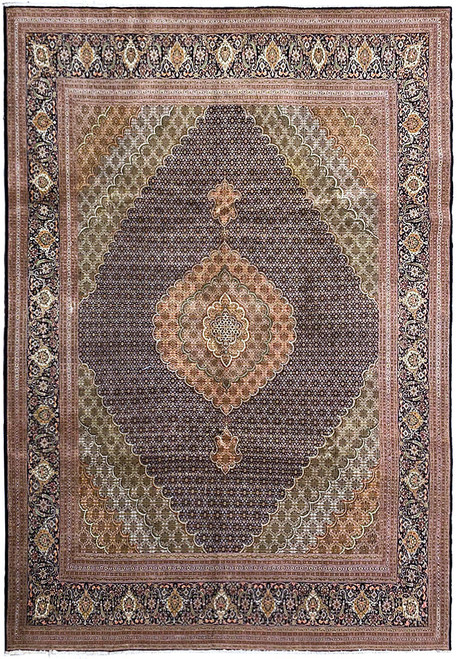
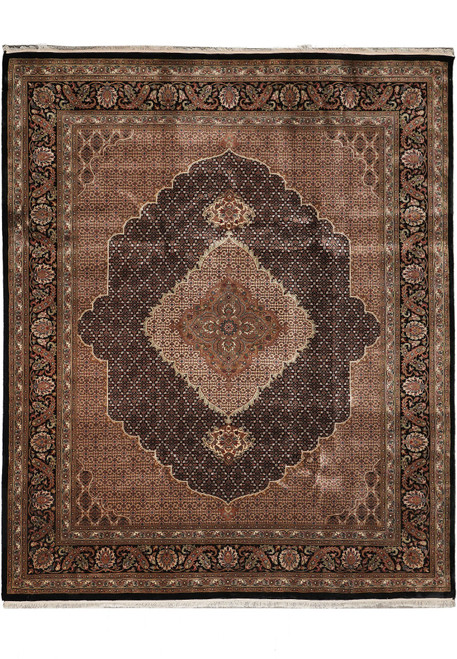
Laid flat, this 8'2" x 10' rug reads as one continuous lattice. A roby red field is filled edge to edge with the herati fish pattern, a black lobed medallion sits dead center, and ivory spandrels open up all 4 corners. The pile is wool with silk knotted through the medallion outlines, the pendant cartouches and many of the small fish leaves, so the surface shifts between matte and sheen as you move around it. The knotting is fine and even, the sides are straight, the ends are finished with plain ivory fringe, and the pile has never been walked on. It ships with a certificate of authenticity recording the hand-knotted construction, the wool and silk pile, the cotton foundation and the country of origin.
Design and Motifs
This is the Mahi drawing in its classic form. Mahi means fish, and the name comes from the herati unit repeated across the field: a small rosette inside a diamond, flanked by 4 curved lanceolate leaves that look like fish circling the flower. The unit repeats hundreds of times in a diagonal lattice, and because the weaver kept the scale small the whole field behaves like a woven textile rather than a picture. At the center sits a scalloped black medallion with an inner cartouche of paler kork toned wool, outlined twice in sage and ivory, with a matching pendant above and below and two small side cartouches at the waist. The ivory spandrels carry the same herati repeat in a lighter key, so the corners glow without introducing a new motif. The main border runs on a near black ground with alternating rosettes, sage and rust palmettes and curling serrated leaves, framed by pale guard bands of running vine and a fine zigzag minor stripe that keeps the outer edge crisp.
Roby Red, Ivory and Sage: A Close Look at the Color
The field is roby red, a deep saturated red with a brick to garnet lean that photographs slightly browner under studio light than it looks in a room. Against it, the herati detail is drawn in ivory, soft sage green, rust, a cool steel blue and near black, and those small ivory quatrefoils are what make the lattice read at a distance. The medallion is the darkest note on the rug, a blue black ground that anchors the center, with its inner field softened to a mushroom brown so the drawing inside stays legible. Ivory carries the 4 corner spandrels and the guard stripes, warming to a light honey where the silk catches. The border repeats the black, sage and rust trio with occasional wine red rosettes and cream leaf tips. It is a warm, low contrast palette overall, dark enough to live with real furniture and busy enough to forgive daily traffic.
Woven in India to the Tabriz Mahi Standard
This rug was made in India, where most of the world's best contemporary hand-knotted weaving is now done, and there is no reason to be shy about that. The Mahi Tabriz cartoon demands a high knot count, because the fish leaves collapse into mush at a coarse gauge, and the back of this piece (see the folded corner photograph) shows a tight, regular grid of knots on a cotton foundation with clean, unbroken rows. That is workshop discipline, not village improvisation. If you are weighing this against other traditional pieces, our guide to what separates a Persian rug from an Oriental rug is worth five minutes. At 8'2" x 10' it belongs with the standard 8 x 10 area rugs, the size that carries a full seating group with the front legs of every piece on the pile.
8'2" x 10' Mahi Tabriz Design Rug | Roby Red Herati Field with Silk Highlights | Never Used
Ask about this rug
This piece is the only one of it, so the things worth knowing about it are particular to it. If you want to talk through the size, the colour in your own light, or the weave, speak to someone here first.