| Size in ft: | Width: 11'10" x Length: 17' |
| Size in Inch: | Width: 142" x Length: 204" |
| Size in meters: | Length: 5.18 x Width: 3.61 m |
| Colors: | Navy Blue, Burgundy, Green, Ivory, Rose Pink, Gold |
| Shape: | Rectangular |
| Woven: | 100% Hand-knotted | Handmade |
| Foundation: | Cotton |
| Pile: | Wool and Silk |
| KPSI: | Approx. 500 |
| Age: | 1970s | Vintage |
| Design: | Tabriz Floral Medallion | Pendant Palmettes | Cartouche Border |
| Origin: | Persian Tabriz | Made in Persia |
| Condition: | Perfect | Excellent |
11'10" x 17' Persian Tabriz Rug | Wool & Silk Floral Medallion | Approx. 500 KPSI, 1970s
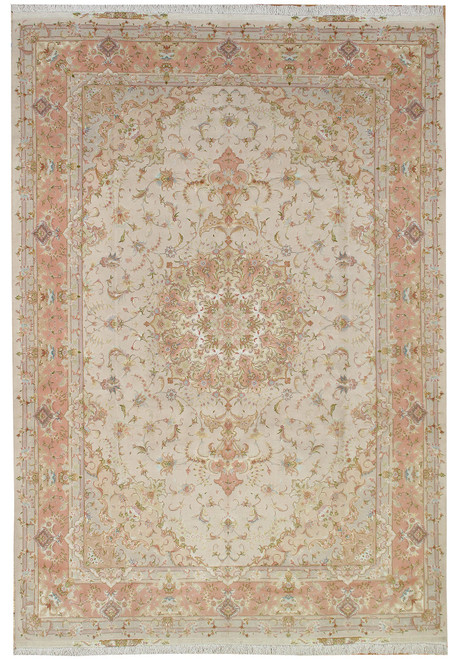
This 11'10" x 17' Persian Tabriz is a palace piece from the 1970s, hand-knotted in fine wool with silk drawn through the highlights over a cotton foundation. The composition is formal and fully resolved: a domed central medallion, pendant palmettes on the long axis, and 4 corner spandrels that pin the midnight blue field in place. Silk is used sparingly and on purpose, catching the light along the vine scrolls and rosette outlines so the surface changes as you cross the room. At 204" long it sits firmly among the true oversize Persian rugs, scaled for a great room or a long formal dining table, and it ships with a certificate of authenticity.
Design and Motifs
The medallion is built in concentric rings: a small rosette at the dead center, then a russet ground filled with scrolling leafwork, then a scalloped ivory and pale green outer ring that reads almost like lacework against the dark field. Above and below it hang cupped pendant cartouches in turquoise and copper, each holding a pair of facing birds. The field itself is not a repeating lattice but a drawn garden, with flowering branches, pink blossom sprays, saffron rosettes and small perching birds worked in among the arabesques. The 4 spandrels carry the boldest drawing in the rug, large chartreuse and ivory palmette clusters with curling cloudbands. The main border runs on a brick red ground with alternating heart-shaped teal cartouches and vase-and-bird panels, separated by light blue guard stripes and an ivory outer stripe finished with a navy sawtooth edge.
A Palette Anchored in Midnight Blue and Burgundy
The field is a deep midnight navy, dark enough that the pale drawing on top of it appears lit from within. Against that ground the weaver ran an unusually wide secondary palette: chartreuse and lime green in the spandrels, ivory and cream in the medallion ring, rose pink and old rose in the blossoms, saffron gold, soft turquoise and teal in the cartouches, and copper brown through the vine work. The main border shifts the whole rug onto a warm brick red to burgundy ground, which keeps the navy from reading cold and gives the piece its formal, slightly antique feeling. Where silk is used, mostly in the rosette outlines, the bird bodies and the finer scrollwork, it reads a full shade brighter than the wool beside it and changes tone completely from one viewing angle to the other.
Woven in Tabriz, Northwest Persia
Tabriz has been the commercial and technical capital of Persian weaving for centuries, and its workshops measure fineness in Raj, the count of knots per gereh across the width. A weave in the region of 500 knots per square inch places this rug well above commercial Tabriz production and into workshop territory, which is exactly what a design of this complexity needs: curved stems, tiny bird heads and shaded petals only hold their shape when the knot count is high enough to draw them. The back, shown in the final photographs, is tight and even across the full 17' length, with the cotton warp and weft packed hard and the pattern legible knot for knot. A rug at this scale and this density was a long commission on the loom, and the discipline of the drawing from one end to the other shows it.
11'10" x 17' Persian Tabriz Rug | Wool & Silk Floral Medallion | Approx. 500 KPSI, 1970s
Ask about this rug
This piece is the only one of it, so the things worth knowing about it are particular to it. If you want to talk through the size, the colour in your own light, or the weave, speak to someone here first.