| Size in ft: | Width: 11'4" x Length: 19'4" |
| Size in Inch: | Width: 136" x Length: 232" |
| Size in meters: | Length: 5.89 x Width: 3.45 m |
| Colors: | Light Blue, Ivory, Green, Red, Brown |
| Shape: | Rectangular |
| Woven: | 100% Hand-knotted | Handmade |
| Foundation: | Cotton |
| Pile: | |
| Age: | 1940's | Antique estate piece |
| Design: | Kerman Floral | Open field with elongated central medallion |
| Origin: | Persian Kerman | Made in Persia |
| Condition: | Very Good | Very minor invisible stains |
11'4" x 19'4" Persian Kerman Rug | Light Blue Open Floral Field | 1940s Estate Piece
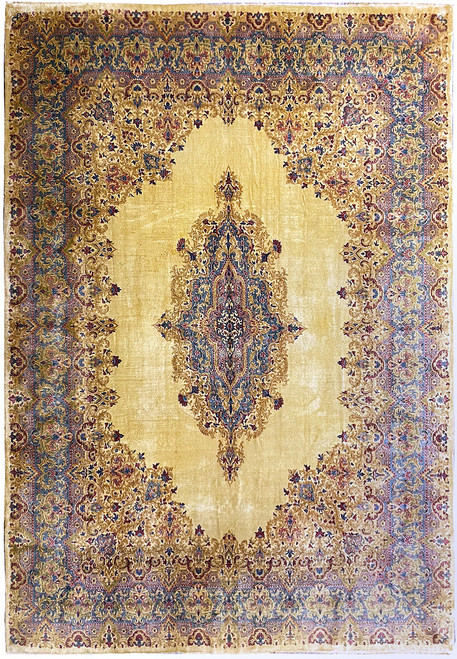
This is a 1940s Persian Kerman that came out of a private estate, and it is the kind of piece that stops a room before anyone steps on it. The field is a soft, clear light blue, unusually open for a Kerman, with a long floral medallion drawn down the center and generous sprays of ivory, rose and coral blossoms gathered around the edges of the field. At 11'4" x 19'4" it belongs in the small group of genuine oversize Persian rugs that can actually cover a 20 foot great room or a long formal dining room without the furniture crowding the border. The wool has settled into that low, silky antique surface you only get after 80 years, and the pile still shows a clean sheen in raking light. Every rug ships with a certificate of authenticity.
Please Note About the Photographs:
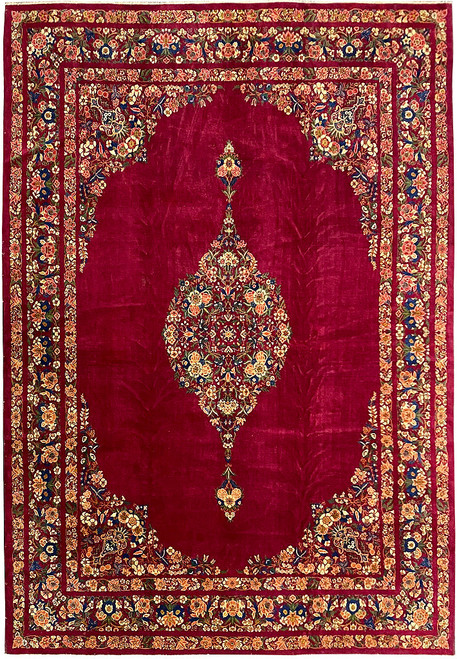
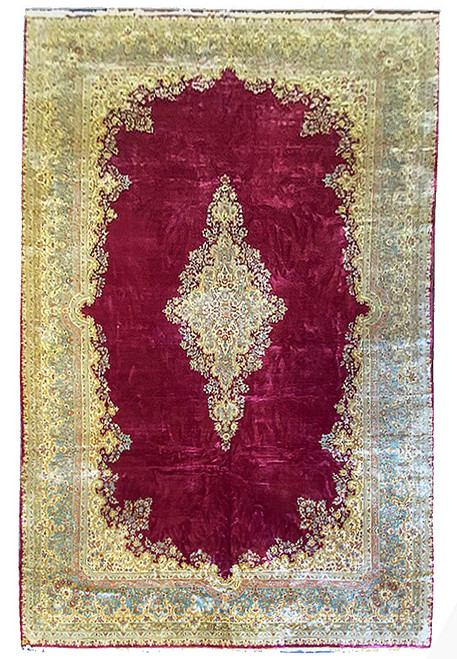
A pale blue field of this size reads differently under every light source. The overhead gallery shot shows the field slightly deeper and greener, while the daylight close-ups show it lighter and cooler. The true color sits between the two, a soft powder blue with a faint aqua cast. The lighter and darker bands visible across the open field in the long shots are natural abrash, the normal variation between dye lots in a hand-knotted antique, not fade or wear. Every rug is professionally steamed and pressed before it ships.
Design and Motifs
The drawing here is classic Kerman restraint. Rather than filling the ground, the weaver left most of the field bare and let the flowers do the work at the edges and along the spine. A tall, elongated medallion runs down the center, built up out of layered rosettes, curling acanthus leaves and small bud clusters, and it tapers into a pendant at each end that trails off into the open blue. Around it, 4 large corner bouquets and a ring of detached floral sprays float across the field like cut flowers laid on a tablecloth. The border is where the density comes back: a wide band of scrolling vine, serrated leaves and repeating blossoms in coral and ivory, framed by narrow guard stripes. Look closely at the field flowers and you can count the individual elements, from 8 petal rosettes to tiny 5 point stars in deep rose, each outlined in rust brown with a small green heart. It is a naturalistic, almost European floral vocabulary, which is exactly what made Kerman the most collected Persian city weave in American homes through the middle of the last century.
The Light Blue Palette
Blue grounds of this tone are rare in antique Persian weaving, and they are the first thing a decorator notices. The field is a soft powder blue with a faint aqua cast, cool and slightly chalky, closer to a robin's egg than to navy, and it holds the whole 19'4" length together as one continuous wash of color. Against it the flowers run warm: salmon and peach in the larger blossoms, a saturated raspberry red in the small buds and star flowers, ivory and cream in the leaf outlines, and small touches of soft apple green at the flower centers that keep the pinks from turning sweet. Rust brown carries the vine work and the outer border, giving the design its structure. The whole scheme is low contrast and sun washed, the kind of palette that works with grey oak floors, pale plaster walls and linen upholstery, and it reads far lighter in person than most antique Persian rugs of this scale. The back of the rug, visible in the fold photograph, shows the same colors at full strength, which tells you the surface tone is honest age and mellowing rather than bleaching.
Kerman Weaving and This 1940s Piece
Kerman sits in the southeast of Persia, a desert city with a weaving tradition that runs back to the Safavid period and a reputation built on drawing rather than raw knot count. Kerman weavers worked from detailed cartoons, used a soft, long staple local wool that takes pastel dyes beautifully, and specialized in the pictorial and naturalistic garden borders that no other Persian town attempted at the same level. This piece is a mid century workshop product, woven in the 1940s on a cotton foundation with a hand-knotted wool pile, clipped low so the fine floral outlines stay crisp, and finished with the full ivory warp fringe still intact at both ends. Weaving a single rug 19 feet long takes a loom and a team that most village workshops never had, which is part of why oversize Kermans of this period survive in small numbers. If you want to understand how pieces like this are placed in time, our guide on how to date an oriental rug walks through the same clues we used here: the dye behavior, the foundation, the pile height and the finish at the selvage.
11'4" x 19'4" Persian Kerman Rug | Light Blue Open Floral Field | 1940s Estate Piece
Ask about this rug
This piece is the only one of it, so the things worth knowing about it are particular to it. If you want to talk through the size, the colour in your own light, or the weave, speak to someone here first.