Watch the film
| Size in ft: | Width: 3'4" x Length: 17'2" |
| Size in Inch: | Width: 40" x Length: 206" |
| Size in meters: | Length: 5.23 x Width: 1.02 m |
| Colors: | Rust, Green, Ivory, Blue |
| Shape: | Runner |
| Woven: | 100% Hand-knotted | Handmade |
| Foundation: | Cotton |
| Pile: | Wool | Low pile |
| Age: | 1950's | Vintage |
| Design: | All-Over Paisley | Boteh Repeat | Ivory Vine Border |
| Origin: | Persian | Made in Persia |
| Condition: | Very Good | Evenly low pile from use |
3'4" x 17'2" Vintage Persian Runner Rug | All-Over Paisley Boteh | 1950s Wool Low Pile
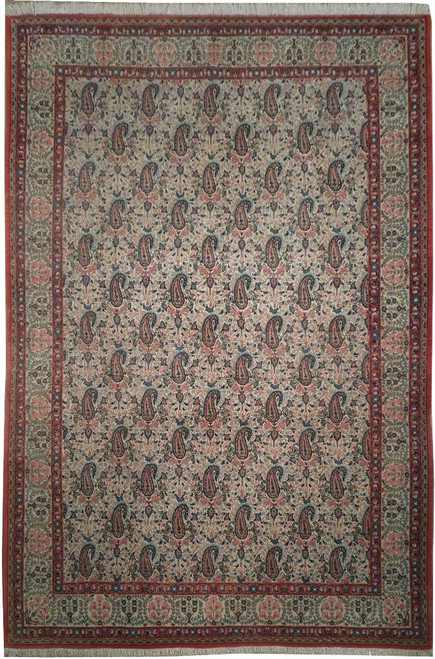
Runners this long are not made to order, they turn up. This one measures 3'4" x 17'2", a true corridor length from the 1950s, hand-knotted in wool on a cotton foundation with an unbroken all-over paisley repeat marching the full 17'2" of the field. The pile has worn down to a low, even nap that makes the drawing read almost like a textile, which is exactly what collectors look for in older Persian runner rugs. Both ends keep their original hand-tied fringe and the selvages are sound, and the piece ships with a certificate of authenticity confirming it as a genuine hand-knotted Persian weaving.
Please Note About the Photographs:
The full-length overhead shot was taken under uneven studio light, so the field reads darker and cooler toward the top than it does in person. The close-up photographs show the true rust tone. The soft shifts in color down the length of the field are abrash, the natural variation of hand-dyed wool, not wear, fade or damage.
Design and Motifs
The field carries no medallion at all. Instead, rows of boteh, the bent paisley figure that gave Western weavers the Paisley shawl pattern, climb the full length in offset ranks, each one outlined in ivory dots and packed inside with small navy rosettes and gold green leaflets so that no 2 adjacent motifs read quite the same. Between the rows sit tiny 4 petal flowerheads and hooked tendrils that fill every gap, which is why the pattern never looks sparse even across 206" of length. The main border is ivory, drawn with a continuous reciprocal vine that turns into a brick red paisley at each repeat, flanked by olive brown minor stripes holding a chain of rose and sky blue rosettes, and then by fine pearl-and-dot guard bands that frame the whole run cleanly. The drawing is village work, confident and slightly irregular, with the boteh leaning a touch as the rows advance, the signature of a weaver working from memory rather than a squared cartoon.
The Colors
The ground is rust, but it is not one flat rust. It moves from a warm brick terracotta through salmon to a softer coral where the older dye lots meet, the kind of depth that only hand-dyed wool gives, and it is the main reason this piece sits comfortably among rust Persian rugs rather than straight reds. Against it the boteh are drawn in deep indigo navy, a brighter mid blue and a clear sky blue, with acid gold green and olive used for the leaf work, so each motif reads as blue and green at once. Ivory appears twice over, as the dotted outlines inside the field and as the full ground of the main border, which lifts the whole runner and keeps the rust from going heavy. Scattered accents of soft rose, mustard and a pale sea green turn up in individual motifs, and the olive brown guard stripes supply the dark line that holds everything together. On the floor the overall impression is warm terracotta with blue and gold detail, ivory edges, and a gentle variation along the length.
Origin and Weave
This is a Persian village weaving from the mid 20th century, made on a narrow upright loom of the sort set up in a single house rather than a city workshop, which is why the width holds steady at 40" over such a long run. The wool is the local high-lanolin fleece that still shows a dry sheen in the raking photographs, knotted at a density typical of good village work and then beaten down firmly, so the back is tight and the handle is supple rather than stiff. The construction is wool pile on a cotton foundation, finished with flat woven ends and the original knotted fringe, and the honest low pile, the abrash in the field and the softened ivory border all point to the same date as the 1950s reading, the kind of evidence you weigh when you set out to date an Oriental rug by wool, dye and weave. At 17'2" it is a genuine architectural length, the solution for a long hallway runner that commercial sizes simply cannot cover.
3'4" x 17'2" Vintage Persian Runner Rug | All-Over Paisley Boteh | 1950s Wool Low Pile
Ask about this rug
This piece is the only one of it, so the things worth knowing about it are particular to it. If you want to talk through the size, the colour in your own light, or the weave, speak to someone here first.