| Size in ft: | Width: 5'2" x Length: 7'9" |
| Size in Inch: | Width: 62" x Length: 93" |
| Size in meters: | Length: 2.36 x Width: 1.57 m |
| Colors: | Blue, Gray, Olive Green, Rust |
| Shape: | Rectangular |
| Woven: | 100% Hand-knotted | Handmade |
| Foundation: | Cotton |
| Pile: | Wool and Silk |
| Age: | 2000's | Unused |
| Design: | Esfahan | Central Medallion | All-Over Floral |
| Origin: | Persian Isfahan | Made in Persia |
| Condition: | Perfect | Unused |
5'2" x 7'9" Persian Isfahan Rug | Navy Wool & Silk Floral Medallion | Unused 2000s Workshop Piece
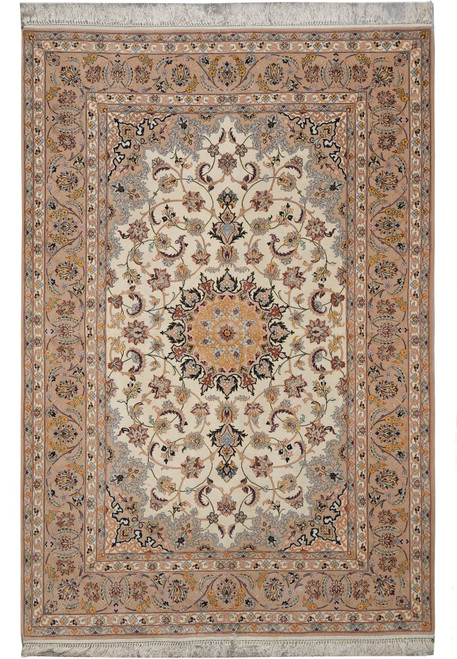
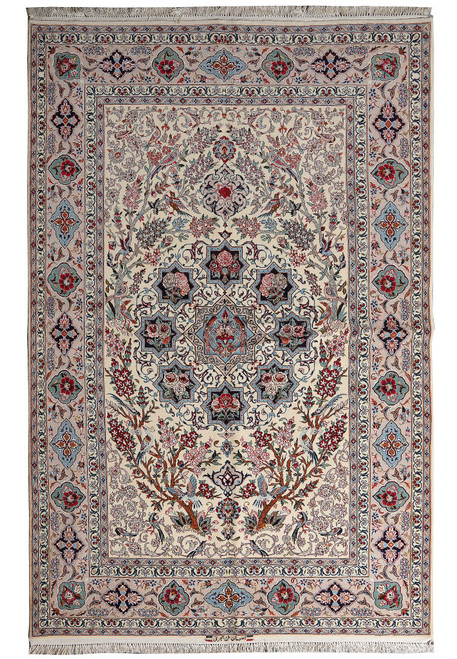
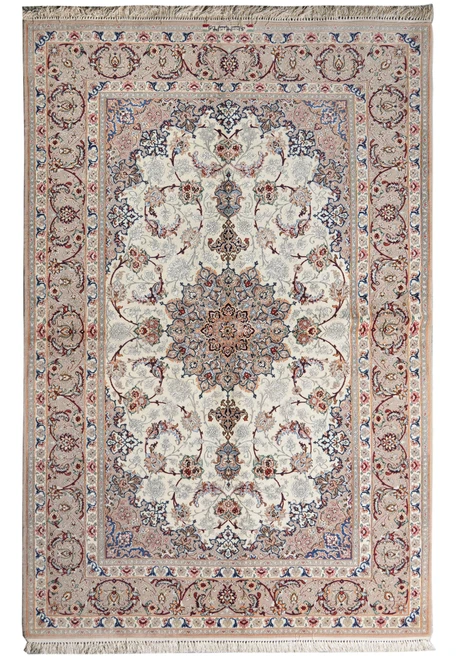
This is a city workshop piece in the truest sense: a 5'2" x 7'9" Persian Isfahan woven in the 2000's, never put on a floor, and still carrying the crisp pile and unbroken fringe of a rug that came off the loom and went straight into storage. The pile is wool with silk worked through the highlights, which is why the ivory leafwork and the pale blue tendrils catch light differently than the matte navy ground around them. Drawing at this level is what separates the best Isfahan rugs from ordinary floral work: every vine closes where it should, every palmette has a clean outline, and the two halves of the field mirror each other without drifting. At 62 by 93 inches it sits comfortably in front of a sofa, under a small dining table, or at the foot of a bed. Every rug we ship leaves with a certificate of authenticity.
Design and Motifs
The field is organized around a lobed central medallion with a small rosette at its exact center, ringed by a dense band of interlaced arabesque tracery and then by a rust-brown lobed collar that throws out 8 pointed leaf tips. Out of the medallion the drawing opens into a full all-over floral system: curling islimi vines, split palmettes, serrated saz leaves and small many-petalled blossoms that repeat in strict mirror symmetry along both the long and short axes. Four corner spandrels carry the same vocabulary at reduced scale, reading as quarter medallions and framing the field cleanly. The border scheme runs 5 bands deep: a narrow guard, a fine floral minor stripe, the wide main border of alternating palmettes and scrolling vine, then a second minor stripe and an outer guard in dark blue. Close photography of the border shows how tightly the artist has held the line, with ivory outlining every flower head so the pattern stays legible even where 6 or 7 colors meet in the space of an inch.
A Navy Field Against Gray, Olive and Rust
The ground is a deep navy blue, almost ink in shadow, and it is the anchor for everything else. Floating over it are ivory and cream blossoms, olive green leaves with softly toothed edges, and small clear accents of apricot orange that appear only in the flower centers and the occasional bud. The main border shifts the whole palette: it reads as a warm gray with a faint mushroom and lilac cast, a color that in Isfahan work is prized because it lets the navy field and the rust detail both sit forward without competing. Rust brown does the structural work, outlining the medallion collar, ringing the minor stripes and edging the border flowers. Slate and powder blue appear in the vine work, and the silk highlights lift the ivory to near white where the light strikes across the pile. Seen from across the room the effect is a cool blue and gray rug with warm embers in it; up close it is a far busier and more varied palette than the first impression suggests.
Isfahan: Central Persia and the Art of the Curved Line
Isfahan sits in central Persia and has been a weaving capital since the Safavid court workshops of the 16th century, when the city set the standard for curvilinear design that the rest of the country then copied. The reputation has always rested on drawing rather than on decoration: a flowing vine, a true curve, a palmette that keeps its shape at small scale. That kind of line only survives at a high knot count, which is why Isfahan looms are strung fine on a cotton foundation and why the weavers there pair wool pile with silk in the highlights. This piece shows the discipline plainly in the mirrored halves of the field, the closed corners and the unbroken border repeat, and the selvedges and fringe are as tight and even as the day the rug was cut from the loom.
5'2" x 7'9" Persian Isfahan Rug | Navy Wool & Silk Floral Medallion | Unused 2000s Workshop Piece
Ask about this rug
This piece is the only one of it, so the things worth knowing about it are particular to it. If you want to talk through the size, the colour in your own light, or the weave, speak to someone here first.