Watch the film
| Size in ft: | Width: 6'1" x Length: 9'5" |
| Size in Inch: | Width: 73" x Length: 113" |
| Size in meters: | Length: 2.87 x Width: 1.85 m |
| Colors: | Cream, Green, Red, Brown, Beige, Blue, Black |
| Shape: | Rectangular |
| Woven: | 100% Hand-knotted | Handmade |
| Foundation: | Cotton |
| Pile: | Wool with Silk Touch Highlights |
| Age: | 1980's | Unused since weaving |
| Design: | Tabriz Animal Design | Central Medallion | All-over Vine Field |
| Origin: | Persian Tabriz | Made in Persia |
| Condition: | Perfect | Never used |
6'1" x 9'5" Persian Tabriz Rug | Cream Animal Design with Green Medallion | 1980s, Never Used
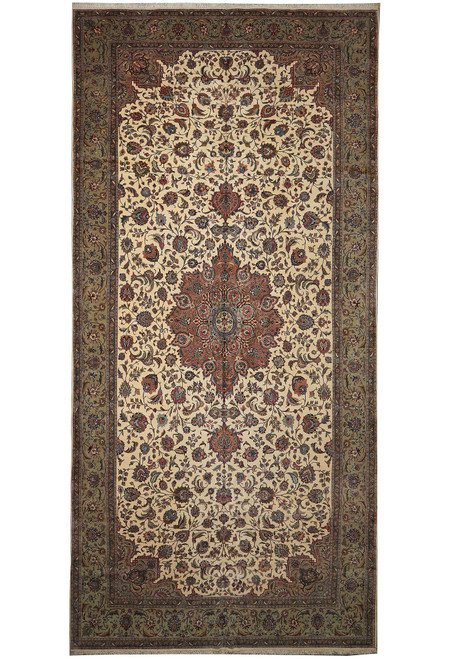
This is a 1980s Tabriz that never made it to a floor. The pile still stands full height across the whole rug, the cream ground has not greyed at the edges the way a used rug does, and the selvedges and fringe are untouched. It is a classic animal design: a green sunburst medallion anchoring a cream field that is alive with deer, gazelles and long-tailed pheasants moving through a lattice of flowering vine. The pile is wool with silk-touch highlights that catch the light in the medallion and the larger palmettes, worked over a cotton foundation on a scale, 6'1" x 9'5", that suits a seating area or a formal dining setting without swallowing the room. Every rug we ship carries a certificate of authenticity documenting origin, materials and hand-knotted construction.
Design and Motifs
The center holds a 16 point green medallion built from layered palmettes and rosettes, with a small rosette at its core and stepped green pendants running off the top and bottom of the field. Matching quarter spandrels in green and rust close the 4 corners, leaving a broad cream ground for the real story: scrolling vines that carry serrated saz leaves, lotus heads, carnations and cloud bands, with pairs of spotted deer and grazing gazelles worked in ivory and tan, and pheasants with sweeping tails perched among the blossoms. The close-up photographs show how the drawing is handled, with the animals outlined in dark brown and shaded in 3 or 4 tones so the bodies have weight rather than reading as flat silhouettes. The main border on a green ground repeats large rust and olive palmettes alternating with leaping deer and birds, framed by rose-brown minor guard borders of small floral meander. This is a curvilinear, workshop-drawn layout, and the fluid line through the vine work is only possible at a tight knot count.
Cream, Green and the Full Palette
The field is a warm cream, closer to unbleached ivory than white, with a faint buttery cast in the wool that reads softer under lamplight than in daylight. Against it the medallion, spandrels and main border run in a muted sage-to-forest green, the single strongest color in the rug and the reason it sits comfortably with olive, sage and natural linen upholstery. Rust and brick red appear in the palmette centers, the flower heads and the spandrel corners, brown carries the outlines and the guard border grounds, and beige and tan build the deer and the softer leaf shading. Small touches of blue, from dusty slate to a deeper navy, punctuate individual rosettes and bird bodies, while black is used sparingly for definition in eyes, stems and petal tips. The silk-touch highlights lift the greens and the cream in raking light, so the medallion appears to change depth as you walk past it. The overall effect is light and warm rather than dark and formal, which is unusual for Tabriz work of this period.
Tabriz Weaving and Quality
Tabriz, in northwest Persia, has been the country's most organized weaving city for centuries, and its workshops are graded by the Raj system, the count of knots across a gereh of about 2.75 inches. Animal and hunting designs like this one are a Tabriz specialty and are only attempted at the finer grades, because the deer, birds and curling vine tips fall apart at a coarse knot. Here the wool is spun fine, the pile is clipped low so the drawing stays sharp, and the back of the rug shows the even, tightly packed row work that separates workshop weaving from village weaving. The cotton foundation gives it a flat, stable lay, and the untouched 1980s pile means a buyer gets the full original wool rather than a rug that has already given away 40 years of surface. If you are shopping the format specifically, this sits within our 6x9 Persian rugs group and among our wider selection of Persian Tabriz rugs.
6'1" x 9'5" Persian Tabriz Rug | Cream Animal Design with Green Medallion | 1980s, Never Used
Ask about this rug
This piece is the only one of it, so the things worth knowing about it are particular to it. If you want to talk through the size, the colour in your own light, or the weave, speak to someone here first.