Watch the film
| Size in ft: | Width: 6' x Length: 9' |
| Size in Inch: | Width: 72" x Length: 108" |
| Size in meters: | Length: 2.74 x Width: 1.83 m |
| Colors: | Ivory, Beige, Sage Green |
| Shape: | Rectangular |
| Woven: | 100% Hand-knotted | Handmade |
| Foundation: | Cotton |
| Pile: | 3/8" Wool and Silk |
| Age: | New |
| Design: | Tabriz All-Over Floral | Multi-Band Cartouche Border |
| Origin: | Made in Pakistan |
| Condition: | Perfect | Never used |
6' x 9' Oriental Rug | Ivory All-Over Tabriz Design | Wool and Silk Pile, Never Used
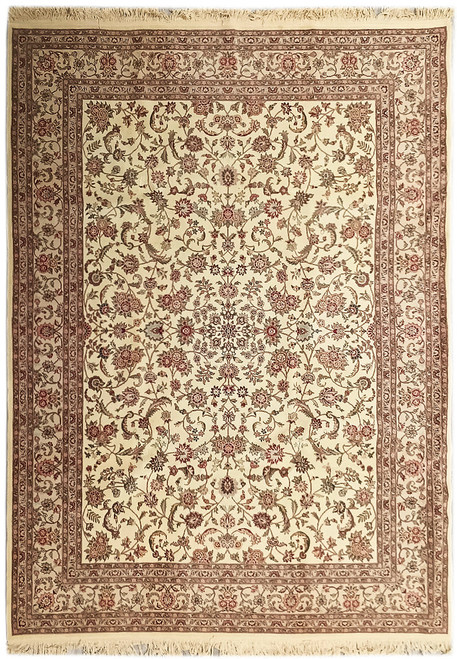
This is a brand new, never used hand-knotted rug in the classical Tabriz manner: an ivory field covered edge to edge in flowering vinework, framed by a beige border built from five separate bands. The pile is a wool and silk blend clipped short, around 3/8 inch, which is what lets the drawing stay crisp and gives the silk-highlighted blossoms their quiet shine when the light moves across them. At 6' x 9' it sits in the most useful of all traditional formats, and buyers comparing 6x9 area rugs will notice immediately how much finer the knotting is here than in most machine-made pieces at this size. Every rug we ship leaves Freeport with a certificate of authenticity confirming it is genuinely hand-knotted, along with its size, materials and origin.
Design and Motifs
There is no medallion here. Instead the weaver ran an all-over floral design across the whole field: curving tendrils that loop back on themselves, carrying large serrated palmettes, 8 petal rosettes, split leaves and small clustered blossoms, with tiny star flowers filling the gaps between the vines. The layout is mirrored on both axes, so a single rosette anchors the center without ever becoming a medallion, and a tall vase-like palmette sits at each end of the field on the main axis. The border system does most of the framing work: a wide beige main band carries alternating brown cartouches and floral sprays, flanked on both sides by narrow guard stripes of running vine and reciprocal trefoil. Corners are resolved properly, with the cartouche turning the angle rather than being cut off, which is a mark of a drafted workshop cartoon rather than improvisation at the loom.
Ivory, Beige and Sage Green in the Pile
The field is a warm ivory, closer to unbleached cream than to white, and it shifts slightly toward butter or toward pale bone depending on where you stand relative to the light, which is normal in a silk-blended pile. Against that ground the leafwork is sage green, muted rather than bright, with a grey-green cast in the shadows. The borders step up into a deeper beige, almost camel, and the cartouches are outlined in a dark walnut brown that gives the frame its definition. Inside the flowers the weaver used small quantities of dusty rose, copper, soft slate blue and old gold, each one no bigger than a single blossom, so the overall reading stays neutral while the close-up detail stays lively. There is no black in the palette and no hard contrast anywhere, which makes this an easy rug to place against oak floors, painted trim or existing upholstery.
Origin and Weaving Quality
This rug was made in Pakistan, where workshops have spent decades weaving classical Tabriz and Shah Abbas patterns to a genuinely fine standard, and it is an honest example of that work: hand-knotted on a cotton foundation, with a wool and silk pile and a short clip that pushes the knot count well above what village weaving usually delivers. If you are weighing it against Persian city work, the distinction is worth understanding, and our guide to Persian rugs vs Oriental rugs sets out exactly where the two traditions diverge. What you can judge from the photographs is the evidence itself: the fringe is even and hand-tied, the selvedges are tight, the drawing holds its curve through the vine scrolls, and the pile has never been walked on.
6' x 9' Oriental Rug | Ivory All-Over Tabriz Design | Wool and Silk Pile, Never Used
Ask about this rug
This piece is the only one of it, so the things worth knowing about it are particular to it. If you want to talk through the size, the colour in your own light, or the weave, speak to someone here first.