Watch the film
| Size in ft: | Width: 8'2" x Length: 11'8" |
| Size in Inch: | Width: 98" x Length: 140" |
| Size in meters: | Length: 3.56 x Width: 2.49 m |
| Colors: | Salmon, Black, Light Blue, Ivory, Olive Green, Rose |
| Shape: | Rectangular |
| Woven: | 100% Hand-knotted | Handmade |
| Foundation: | Cotton |
| Pile: | |
| Design: | Tabriz | All-Over Floral | Multiple Guard Borders |
| Origin: | Persian Tabriz | Made in Persia |
| Condition: | Excellent |
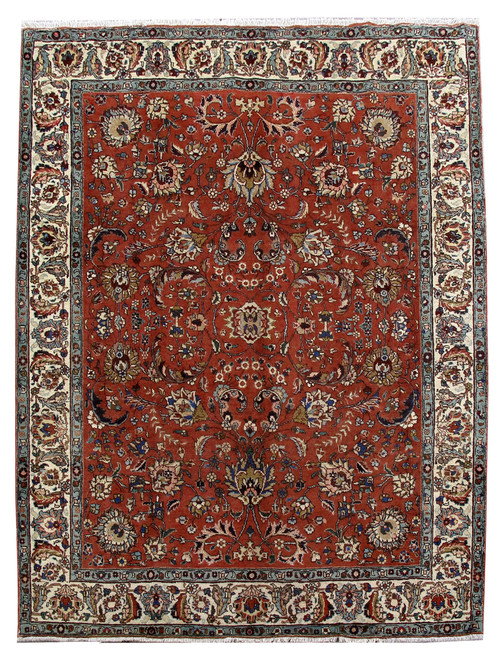
8'2" x 11'8" Persian Tabriz Rug | All-Over Floral Salmon Field | Black Border, Excellent Condition
This 8'2" x 11'8" hand-knotted Persian Tabriz carries a salmon field covered edge to edge in fine floral drawing, held inside a deep black main border and a run of pale blue guard stripes. It is a proper workshop piece: cotton foundation, close-clipped wool pile, straight sides and even selvages, with the drawing repeating cleanly across a field that is nearly 12 feet long. The pile still stands full with no low spots or restoration, and the ivory cotton fringe is intact at both ends. Among large Persian rugs this is an unusually versatile footprint, wide enough to hold a full seating group or a 8 seat dining table. Every rug we ship leaves Freeport with a certificate of authenticity confirming origin, materials and hand-knotted construction.
Design and Motifs
There is no central medallion here. The weaver used a classic all-over floral design, a continuous lattice of curling vines that carries lotus palmettes, multi petal rosettes, split leaves and small four petal blossoms in mirrored repeat across the full field. Look closely at the center and the repeat forms a soft implied medallion out of the massing of larger palmettes, a quiet effect that only good drawing achieves. The main border is a broad turtle-and-palmette vine on black, with alternating rose and ivory blossoms swinging from a thin serpentine stem. Flanking it are light blue guard bands carrying a running cloverleaf and rosette meander, then narrow reciprocal minor stripes that frame the whole composition. The corners resolve correctly, a mark of a drawn cartoon rather than an improvised village weave, and the field ends in a neat inner line rather than being cut off mid motif.
A Salmon Field Framed in Black and Ice Blue
The field is salmon, warm and slightly dusty, reading closer to terracotta under overhead light and shifting toward a soft rose pink where the pile lies the other way. That tone is the whole reason this rug works in a modern room: it gives you the warmth of a traditional red without the weight of a true burgundy. Against it the drawing is carried in ivory, powder blue, olive and moss green, camel gold and a deeper indigo, so the vines read cool while the ground stays warm. The main border is an inky blue-black that anchors all of it and makes the salmon look brighter than it would on its own, while the pale ice blue guard stripes act as a bright seam between border and field. Rose and coral flowerheads in the border pick up the field colour and tie the two zones together. The ivory fringe and the salmon-toned outer edge finish it cleanly.
Tabriz Weaving in Northwest Persia
Tabriz sits in the northwest of Persia and has been the country's most organized weaving city for centuries, working from drawn cartoons in master workshops rather than from memory. Tabriz weavers count fineness in Raj, the number of knots across a gereh of roughly 2.75 inches, and the system exists because these workshops compete on precision: 40 Raj is commercial work, 50 is fine, and 60 Raj and above is collector territory. Fineness is what lets a curved vine stay curved, and on this piece the arabesques turn smoothly through the palmettes with no stair stepping, which tells you the knot count is well above village level. The back shows a tight, regular grid on a cotton foundation with the knot rows sitting straight, and the pile is clipped short in the Tabriz manner so the pattern stays sharp. Tough highland wool and disciplined workshop drawing are why a rug like this holds up for generations under real furniture.
8'2" x 11'8" Persian Tabriz Rug | All-Over Floral Salmon Field | Black Border, Excellent Condition
Ask about this rug
This piece is the only one of it, so the things worth knowing about it are particular to it. If you want to talk through the size, the colour in your own light, or the weave, speak to someone here first.