Watch the film
| Size in ft: | Width: 8'7" x Length: 12' |
| Size in Inch: | Width: 103" x Length: 144" |
| Size in meters: | Length: 3.66 x Width: 2.62 m |
| Colors: | Antique Red, Blue, Olive Green |
| Shape: | Rectangular |
| Woven: | Hand-Knotted |
| Pile: | Wool |
| Origin: | Persia |
| Design: | Esfahan |
| Age: | 1970's |
| Condition: | Excellent |
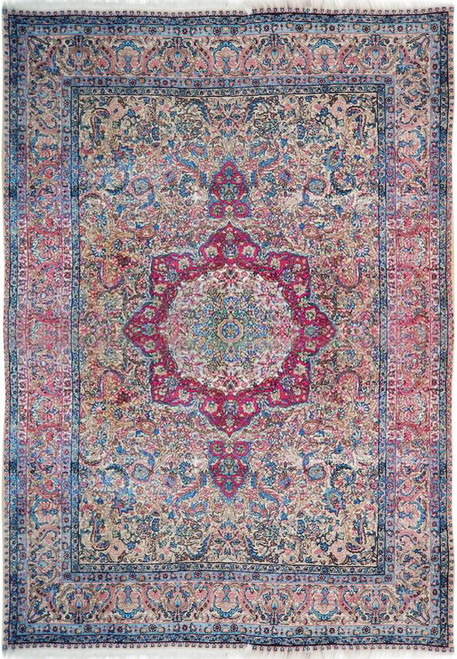
8'7" x 12' Persian Isfahan Rug | Antique Red Floral Medallion | 1970s Wool, Approx. 300 KPSI
This 8'7" x 12' piece is a semi-antique of the 1970s, hand-knotted in wool on a cotton foundation and drawn in the curvilinear manner that made Persian Isfahan rugs the benchmark for fine floral drawing. Roughly 50 years of gentle use have softened the wool into that low sheen a new rug cannot fake, yet the pile is still full from end to end, the ivory fringe is original and the selvages are sound. At just under 9 feet by 12 feet it settles naturally into the proportions buyers look for in 9x12 Persian rugs, covering a full seating group or a dining table with chairs pulled clear. Every rug we ship travels with a certificate of authenticity recording its size, origin, materials and weave.
Please Note About the Photographs:
One image is an extreme close-up taken a few inches from the pile, and the camera flash pushes the salmon ground of the medallion toward a brighter pink than it reads in person. The flat overhead photographs are the truer guide to the color. That macro is there to show pile depth, wool quality and knot definition, not the overall tone of the rug.
Design and Motifs
The composition is the classic Isfahan arrangement: an 8 lobed central medallion built in layers, opening from a small dark rosette at the very center out through ivory and salmon rings into teal blue cartouche lobes, with paired pendants running up and down the long axis. Around it the field never goes quiet. Thin gray-blue vines travel corner to corner carrying palmettes, split leaves, rosettes, tulip heads and small bud clusters, each flower outlined so cleanly that individual stems stay readable from standing height. Quarter medallions anchor the 4 corners in ivory and pale slate, echoing the center rather than copying it. The border system runs 5 bands deep: a navy main border of alternating palmettes and scrolling arabesques, flanked by ivory guard borders filled with a serpentine vine, then narrow red and blue minor stripes that frame the whole field. The scalloped ivory line where the field meets the border is drawn freehand and gives the rug its soft, almost lace-like inner edge.
A Palette Built on Antique Red, Navy and Olive Green
The field is an antique red that has mellowed off the hard tomato tone of a new rug into something closer to old brick, warm under lamplight and slightly cooler by day. Against it the main border sits in a deep navy blue that reads almost indigo in the corners, and the two ivory guard bands keep the red and the navy from crowding each other. The medallion supplies the lighter accents: salmon and soft rose in the inner rings, a chalky ivory in the second layer, and a dusty teal blue that repeats through the palmettes and leaf tips across the whole field. Olive green does quiet but important work, filling leaf bodies and small calyxes, and it is the tone that keeps the reds and blues from reading as a two color rug. Charcoal and near-black outlines give every flower its edge, while touches of gold and camel appear in the border rosettes. It is a warm, saturated, thoroughly traditional palette that flatters walnut and mahogany furniture and holds its own against white walls.
Isfahan Origin and Weaving Quality
Isfahan lies in central Persia and has been a workshop city since the Safavid court set up its looms there in the 16th century. Its whole reputation rests on drawing: the curved line, the unbroken vine, the flower that stays a flower at any scale, and none of that is possible without knot count behind it. At approximately 300 knots per square inch this rug carries far more resolution than a village weave, which is exactly why the vine stems stay thin and continuous and the medallion lobes keep their true curve rather than stepping. The reverse, shown against the ruler, tells the same story: a tight, even, cotton warped back where the design is as legible from behind as it is from the front. The wool is spun from good quality fleece, tightly packed and still dense underfoot after 5 decades, and the weave is regular enough across 12 feet of length that the borders remain square and the rug lies flat without coaxing.
8'7" x 12' Persian Isfahan Rug | Antique Red Floral Medallion | 1970s Wool, Approx. 300 KPSI
Ask about this rug
This piece is the only one of it, so the things worth knowing about it are particular to it. If you want to talk through the size, the colour in your own light, or the weave, speak to someone here first.