Watch the film
| Size in ft: | Width: 8'8" x Length: 11'6" |
| Size in Inch: | Width: 104" x Length: 138" |
| Size in meters: | Length: 3.51 x Width: 2.64 m |
| Colors: | Ivory, Burgundy, Green |
| Shape: | Rectangular |
| Woven: | 100% Hand-knotted | Handmade |
| Foundation: | 100% Cotton |
| Pile: | 3/8" Wool and Silk |
| Design: | Tabriz Gonbadi | Dome Star Medallion |
| Origin: | Made in China |
| Condition: | Brand New | Never used |
8'8" x 11'6" Sino Oriental Rug | Tabriz Gonbadi Dome Design | Wool & Silk Pile | Brand New
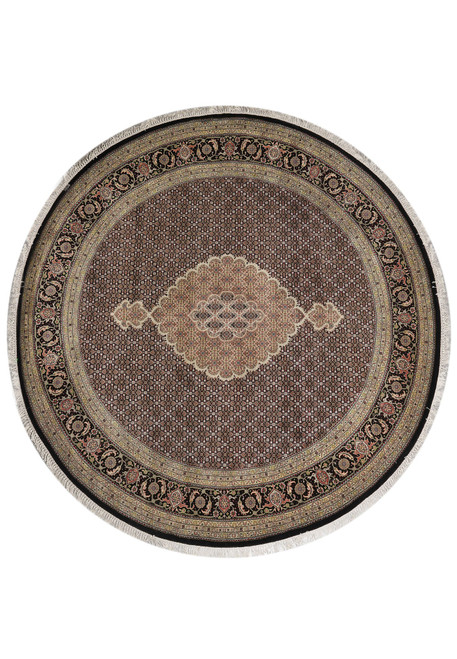
This is the Gonbadi, the dome drawing, one of the most demanding cartoons in the Tabriz repertoire and the reason this rug looks less like a floor covering and more like the underside of a tiled vault. The whole 8'8" x 11'6" field is built from a single point at the center, a star medallion from which radiating ribs and arched panels open outward to the border, so the eye is pulled into the middle no matter where you stand. The pile is wool and silk clipped to 3/8", low enough that the fine drawing stays legible, and the silk picks up light along the vine work and the arch spines as you walk past. It is brand new and never used, with a clean white cotton fringe and full, even pile edge to edge, and it ships with a certificate of authenticity. This is an Oriental rug woven in China to a classical Tabriz cartoon, not a Persian piece, and it is priced accordingly.
Design and Motifs
At the heart sits a camel and cream rosette surrounded by a multi pointed star whose arms are filled with dark wine panels, each one carrying a small framed flower head. Around that star runs a ring of stepped tile compartments, then the ribs of the dome fan out toward the 4 corners, dividing the field into tall arched panels. Every panel is drawn separately: some hold trailing arabesque vine and palmettes on an ivory ground, others carry upright flowering sprays and small vessel forms, and the spines between them are outlined in fine boteh style scrollwork so the ribs read as raised architecture rather than flat lines. The main border is a classical cartouche band, alternating elongated wine medallions with 8 petal rosettes and octagonal floral panels on a sage ground, flanked by narrow guard stripes and a barber pole diagonal band that frames the whole piece. The corner solutions resolve cleanly, which is the first place a rushed weave falls apart and the first place to look when you judge a Gonbadi.
A Palette of Ivory, Burgundy and Sage Green
The ground is ivory, warm rather than stark, moving toward cream and pale taupe where the vine work is densest. Against it the burgundy does the structural work: deep wine outlines the star arms, the cartouche medallions in the border and the small framed blossoms inside the tile compartments, and it reads almost brown-black in the shaded photographs and clearly red under direct light. The green is a soft sage that shades toward khaki and olive in the main border and in the leafwork, a quiet color that keeps the ivory from going cold. Through the field there are salmon and dusty rose flower heads, camel and honey tones in the medallion center, and small punctuation marks of light blue and dark indigo in the individual blossoms. The overall effect is neutral from across the room, ivory and soft green with red accents, and much more colorful up close, which is exactly what makes a rug like this easy to live with in a formal room.
Sino Weaving in the Tabriz Tradition
Chinese workshops have spent decades weaving from classical northwest Asian cartoons, and the best of that output, sold in the trade as Sino, is fine, tightly drawn and honestly made. This piece shows it: a hand-knotted wool and silk pile on a cotton foundation, knots dense enough to carry the hairline outlines of the dome ribs, straight selvages and a level, unclipped-looking surface on both the flat and angled photographs. A curvilinear Gonbadi needs knot count before it needs anything else, because the arches turn continuously and any coarseness shows up immediately as stepping along the curve. Here the curves hold. At 8'8" x 11'6" it sits in the practical 9x12 rug size band, large enough to carry a full seating group or a dining table with chairs pulled clear of the border, and the centered dome composition rewards a room where you can see the whole field at once.
8'8" x 11'6" Sino Oriental Rug | Tabriz Gonbadi Dome Design | Wool & Silk Pile | Brand New
Ask about this rug
This piece is the only one of it, so the things worth knowing about it are particular to it. If you want to talk through the size, the colour in your own light, or the weave, speak to someone here first.