


Watch the film
| Size in ft: | Width: 9'11" x Length: 13'3" |
| Size in Inch: | Width: 119" x Length: 159" |
| Size in meters: | Length: 4.04 x Width: 3.02 m |
| Colors: | Purple Blue, Red, Pink, Ivory, Apricot, Teal |
| Shape: | Rectangular |
| Woven: | 100% Hand-knotted | Handmade |
| Foundation: | Cotton |
| Pile: | |
| Age: | 1980's |
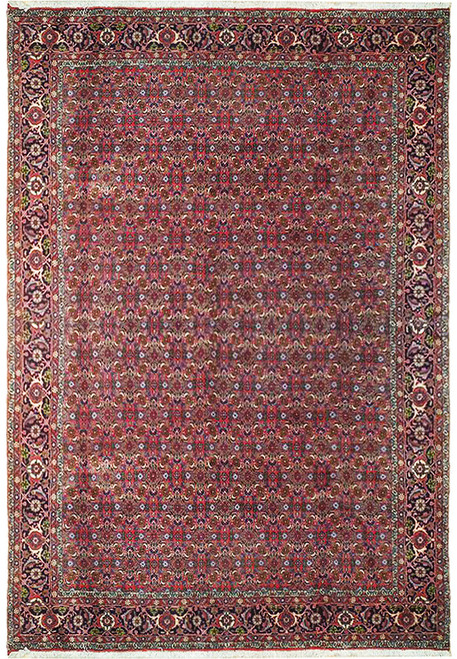
| Design: | Mahal | Bijar-style Herati all over | Small diamond medallion |
| Origin: | Persian Mahal | Made in Persia |
| Condition: | Excellent | Full even pile |
9'11" x 13'3" Persian Mahal Rug | Bijar Herati All Over Design | 1980s Purple Blue & Red
This is a village-woven Persian Mahal from the 1980s, 9'11" x 13'3", carrying a Bijar-style Herati lattice across a deep purple blue field with a single small diamond medallion at the center. The wool is heavy and glossy, the pile is full and even end to end, and the handle has the weight you expect from a west central Persian loom rather than a thin commercial weave. At nearly 10 feet by 13 feet it covers a full seating group or a 10 seat table, and it sits comfortably within our range of 10x13 Persian rugs. Every rug we sell ships with a certificate of authenticity confirming the origin, the hand-knotted construction and the materials.
Design and Motifs
The field is the classic Herati, also called mahi or the fish pattern: a continuous diamond lattice, a rosette set inside each diamond, and 4 curved lanceolate leaves turning around it, repeated hundreds of times across the ground. It is the drawing most associated with Bijar weaving, and you can read the full background in our guide to Bijar Herati rugs. Here the weaver interrupted the repeat only once, with a small apricot-outlined diamond medallion on a red ground filled with 8 petal rosettes and tiny paisley forms, plus matching pendants at top and bottom. The 4 corners are cut with large ivory spandrels drawn in open floral sprays, which gives the dense all over Herati design room to breathe. Framing it all is a wide red main border of palmettes and rosettes on a black-drawn vine, flanked by ivory guard stripes, a narrow reciprocal striped band, and a plain purple blue selvage edge that finishes the rug cleanly.
A Purple Blue Field With Rose, Red and Teal
The ground reads as a deep indigo with a clear purple, almost aubergine cast, which is what separates this piece from the standard navy village rug and makes it one of the more unusual purple blue and navy Persian rugs we carry. Against it the lattice is drawn in tomato red and brick red, with the rosettes picked out in soft rose pink, salmon, blush and ivory, so the overall impression from standing height is a plum-toned field shot through with pink. Small hits of teal and turquoise appear in the leaf tips and rosette centers, and single notes of black give each flower a defined eye. The medallion outline and its pendants are a bright apricot orange, the one warm accent in the whole field. In the border the red is clearer and cooler, lifted by cream palmettes, pale blue petals and more turquoise, while the ivory spandrels and guard stripes keep the dark field from closing in. Under daylight, as in the room photo, the purple softens toward plum red; under lamplight the blue comes forward.
Mahal Weaving in West Central Persia
Mahal rugs come from the villages of the Mahallat district in the Arak region of west central Persia, the same weaving belt that produced the old Sultanabad carpets sold to Europe and America from the late 19th century onward. The looms there are village looms, wide enough for generous room sizes, and the tradition favors bold repeating field patterns, heavy local wool and a thick pile over the miniature precision of a city workshop. That is exactly what this rug shows: a cotton foundation, a medium-fine village knot count, and a tall springy wool pile that takes furniture weight and foot traffic without flattening. The back, visible in the final photograph, is evenly knotted with straight, well-packed rows and no repairs or restoration, and the wool still carries its natural lanolin sheen. Woven in the 1980s, it is now a genuine semi-antique; if you want to see how age is read from the reverse side, our article on how to date an Oriental rug walks through the same clues we use on the floor.
9'11" x 13'3" Persian Mahal Rug | Bijar Herati All Over Design | 1980s Purple Blue & Red
Ask about this rug
This piece is the only one of it, so the things worth knowing about it are particular to it. If you want to talk through the size, the colour in your own light, or the weave, speak to someone here first.
Related rugs
-
-

-

-

-
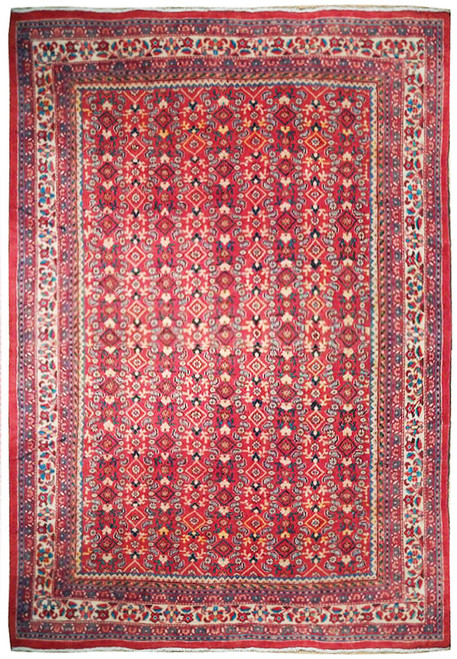
9'4" x 12'6" Persian Mahal Rug | Red Field | All-Over Herati Design | Diamond Compartments
Was: $3,640.00Now: $3,499.00