Bokhara Rugs
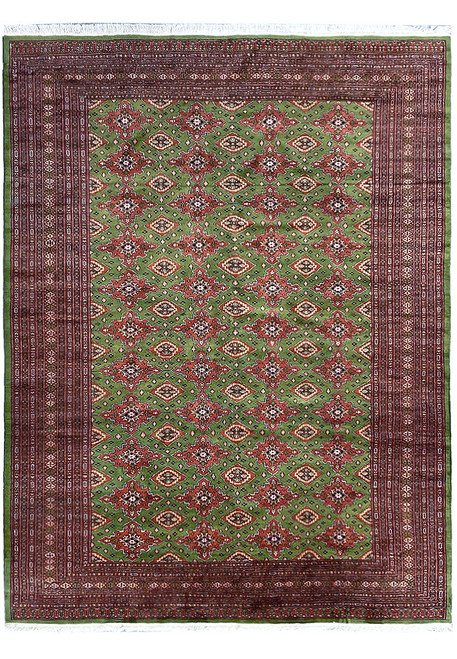
Bokhara is a market, not a weave. The city of Bukhara sold rugs that Turkmen tribes wove out on the steppe, and the name stuck to the goods rather than to the makers. What it describes is a rug covered edge to edge in one repeated device, the gul, set out in rows on a red ground. Most Bokharas made now are woven in Pakistan.
The name belonged to the middleman
The weaving was Turkmen, spread across what is now Turkmenistan, northern Afghanistan and the north-east of Iran. Bukhara was where the rugs were bought and sold, and European buyers named them after the place they met them. Antique pieces are sorted by tribe instead: Tekke, Yomut, Salor, Saryk, Ersari. The phrase the trade uses most, royal Bokhara, almost always means the Tekke gul, and it is a grade word rather than a court one. The whole group sits inside tribal weaving, though it is the most disciplined tribal weaving there is.
What a gul actually is
A gul is a flattened octagon or lozenge, quartered into blocks of contrasting colour, repeated on a strict grid with a smaller secondary device filling the spaces between rows. It is a tribal ensign, not a flower arrangement, and different tribes carried different guls, which is how attribution is done. The ends of a main carpet often carry an elem, a plain or lightly drawn panel that was meant to sit at the edge of a tent. The other format worth knowing is the ensi, a rug divided into four panels by a cross, made as a tent door and sold ever since as a prayer rug, which it was not.
Single knot and double knot
Pakistani workshops took up the design in the second half of the twentieth century and now account for most production. The trade grades that weaving as single knot or double knot. In practice the double knot is the coarser, denser build: more wool per square foot, a heavier handle, and outlines on the gul that are marginally softer. Single knot work is finer and the drawing is crisper for it. Neither is a fault and both are new rugs made to a spec, but the words do describe something real, so it is worth asking which one is in front of you.
Why one repeat reads sharp and another blurs
An octagon drawn on a grid of knots is only as clean as the grid and the clip. Bokharas are clipped short, much shorter than a Kazak, and the short clip is why the pattern can look almost printed. Let the pile run longer, or drop the knot count, and the edges of each gul fur over while the rows lose their alignment down the rug. The short clip has a second consequence: lustrous wool cut level reflects strongly in one direction, so a Bokhara often reads dark from one end of the room and much lighter from the other. Walk around it before deciding what colour it is.
Red, and the little that joins it
The ground is red by default, from deep madder to a brick tone, with the guls picked out in ivory, indigo and a brown so dark it works as black outline. Modern production widened that: ivory, gold and dark grounds are all common now. The palette is small in every version, which is the point. A repeat needs few colours or it turns into noise.
What the repeat is good for, and where it fails
A field with no centre is genuinely useful. Furniture can sit anywhere without cutting a medallion in half, a sofa can move across the room, and the rug still makes sense. That is why the design works so well in runners and in small sizes, where a medallion layout would simply be cramped. The failure is at the other end. In 12x18 formats the repeat stops being a pattern and becomes a texture, read from across the room as a single red rectangle, and a rug with no focal point cannot carry a large empty floor on its own. If the room needs a middle, look at a medallion weave such as Kashan or Sarouk instead.
-
-

9' x 12' Bokhara Rug | Beige Field with Peach & Black Guls | Oriental Hand-Knotted Wool
Was: $5,280.00Now: $4,780.00 -

-

-

-

-

-

-

-

-

-
