Flat-Weave Rugs
A flat weave has no pile. Nothing stands up off the surface, because the pattern is the structure itself: coloured weft threads packed down over the warps until the warps disappear. That makes the rug thin, light, usually reversible and able to sit under a door that a knotted rug would jam. It also means it hides nothing at all.
The pattern is the structure
In a knotted rug the foundation is one thing and the pattern is another: rows of knots tied onto warps that stay hidden underneath. A flat weave has no second layer. The weaver builds the design out of the weft itself, changing colour as the drawing requires and beating each pass down hard. Nothing is added afterwards and nothing can be corrected, which is why a flat weave records a weaver's decisions more exactly than a pile rug ever does.
The slit, and why kilims lean on the diagonal
The commonest technique is slit tapestry. Where two colours meet along a vertical line, each weft turns back on its own warp and a small slit opens between them. A long vertical boundary would open a long slit and weaken the rug, so kilim design avoids it: shapes are built from diagonals, steps and hooks, and outlines are drawn as staircases. The angular vocabulary that reads as a tribal style is in fact a structural constraint. It is the same grammar found in Caucasian and Kazak knotting, arrived at along a different road.
Kilim at the informal end
Kilims are woven across Turkey, Persia, the Caucasus and Afghanistan, largely by the same people who weave tribal pile rugs, and Qashqai and Shiraz weaving covers both. They were domestic objects first: floor covers, bedding, grain sacks, tent dividers. That is why so many old ones are narrow, or made in two halves and sewn up the middle. The Indian dhurrie is the same idea worked mostly in cotton. Nothing about a kilim is formal, and that is the appeal of one.
Soumak, the exception
Soumak breaks most of the rules above. The weft is wrapped around the warps rather than passed straight through, which gives a dense herringbone surface and considerable strength. The loose ends of each wrapped yarn are left hanging on the reverse, so a soumak has a right side and a wrong side and cannot be turned over. It is thicker and heavier than a kilim and behaves in use rather like a pile rug, minus the pile.
Aubusson at the formal end
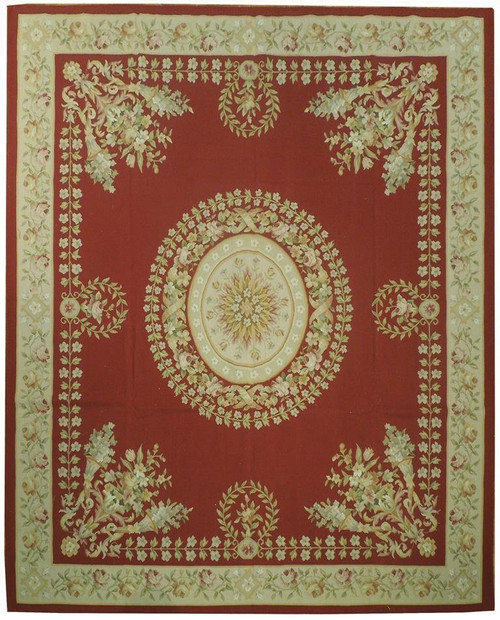
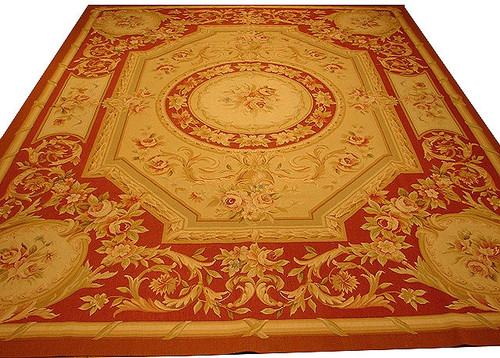
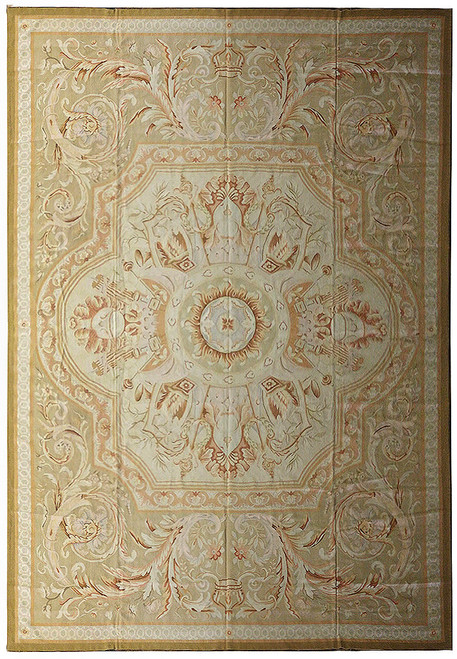
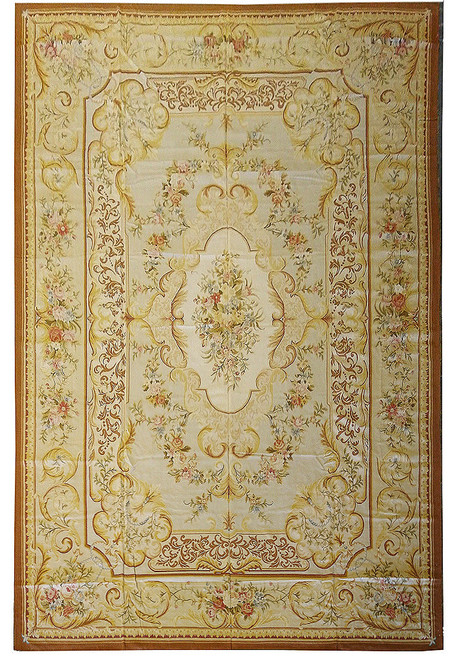
The same construction in France produced something entirely different. An Aubusson is a tapestry weave carrying eighteenth and nineteenth century drawing: wreaths, acanthus, garlands, a soft palette of rose, sage and cream. It reads as a painting laid on a floor rather than as a textile, and it is the reason the European tradition in this catalogue contains no knotted rugs. Same technique as a village kilim, opposite intention.
What it is genuinely good for
Under a door. In a narrow passage where thickness is a nuisance. Layered over a larger rug or over carpet. In a room that keeps changing its use, or anywhere the rug has to be lifted and moved by one person. Because most of them are reversible, wear can be evened out by turning the rug over, which no pile rug allows. It is the practical answer in runner and accent formats, and it takes a modern graphic design as readily as it takes an old one.
What it cannot do
A pile hides soil, cushions a step and springs back when crushed. A flat weave does none of the three. It shows a spill at once, it is cold and hard underfoot, it slides on a polished floor unless something is laid beneath it, and under heavy traffic it thins rather than wearing evenly. In a room where people eat, that matters more than the saving does. For a hall or a dining room the sensible choice is a thick wool pile, and certainly not silk.