Rectangular Rugs
A loom is a rectangle. Two beams, warps running between them, width fixed by the frame and length added as the weaving progresses. Every rectangular rug is simply the shape the tool makes, and every other shape is a deliberate departure from it. That is why this is the only shape where the choice is complete: every tradition, every size, every level of fineness.
The proportions have names
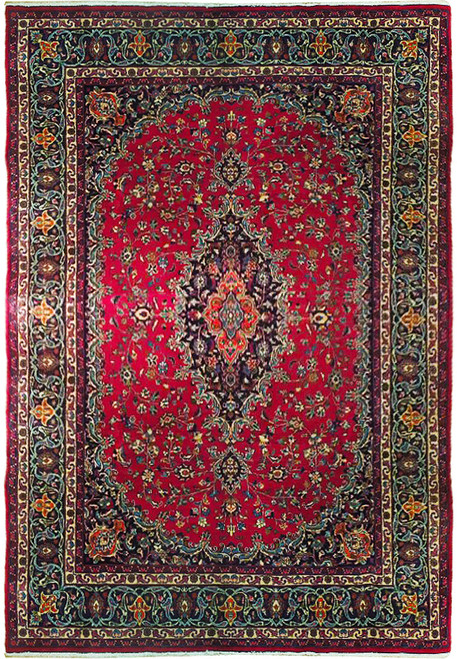
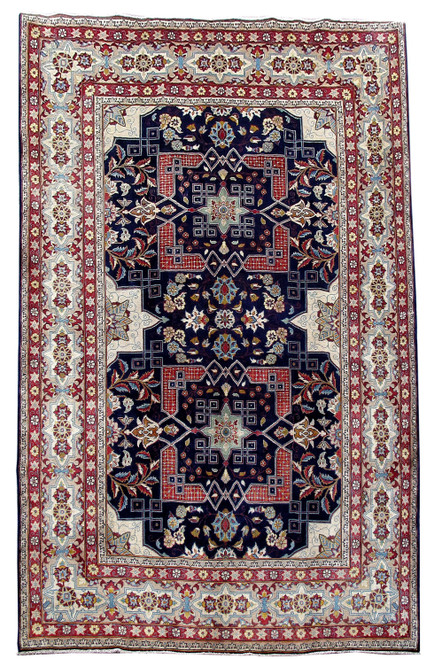
Persian weaving did not treat a rectangle as one shape but as several, each with a name and a purpose. A dozar, two zar, is roughly 4 and a half by 6 and a half feet, the ordinary rug of a house. A zaronim is half as long again as it is wide. A kellegi is a long rug, three or four times its width, made to sit at the head of a room. A kenareh is narrower still and runs along the side. The proportions are functional, not decorative, and they describe how a Persian room was actually furnished.
The three-rug room
Before Western room-sized carpets became the export standard, a formal Persian reception room was floored with a set: one broad kellegi across the head of the room where the host sat, and two long kenareh down the sides, sometimes with a square-ish piece in the middle. That is why long narrow rugs exist in such numbers and why so many antique kellegi are orphans, separated from the set they were woven with. It is also a genuinely good solution for a modern room that is too long for one rug.
What the shape gives a buyer
Choice, and nothing else is close. Village weaving such as Hamadan, workshop weaving such as Tabriz, and the large village format of Heriz all come rectangular as a matter of course, across Persian weaving generally and in every band from 6x9 up to 8x10. Tribal work is rectangular without exception, because a tribal loom cannot be anything else. Ask for a square, a round or an oval rug and the field of candidates narrows immediately, which is the honest case for staying rectangular unless the room insists otherwise.
One thing to expect
A hand-knotted rectangle is not a true rectangle. It was woven under tension on a wooden frame by hand, so it may be an inch or two wider at one end, and the sides may not be perfectly straight. A good wash and block improves it. A rug that is dead square to the millimetre was made by a machine. See the other formats at rug shapes.