Tabriz Rugs
Tabriz has woven carpets longer than almost anywhere in Iran, and it has never settled on a single level of quality. The name covers a plain commercial rug with a thick pile and a silk-outlined workshop piece fine enough to hold a curve. Both are honestly Tabriz. Which is why the first useful question about one is not the design. It is the raj.
The raj, and what it actually measures
Raj is the Tabriz unit of fineness. It counts the knots across a fixed width of the rug, conventionally about seven centimetres, and the trade quotes it in round steps: 25, 30, 40, 50, 60 and 70 raj, with higher numbers reserved for exhibition work. A 30 raj rug has a clear pattern, a generous pile and visible steps where a curve turns. A 50 or 60 raj rug can draw the same curve smoothly, because the grid it is drawn on is finer. That is the whole meaning of the number. It says how much drawing room the weaver had. It does not say how long the rug will last, and a low raj is not a fault any more than a thick sweater is a fault.
Mahi, the fish that is nobody's fish
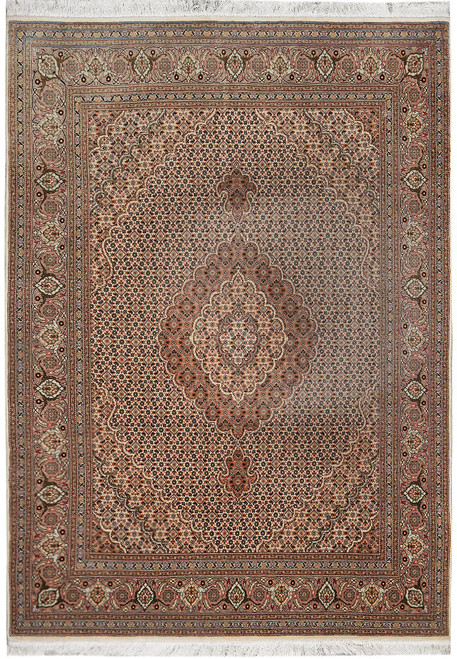
The field most associated with the city is the Mahi, which the trade also calls the fish pattern. It is an all-over repeat built from a small rosette inside a diamond, flanked by four curved lanceolate leaves. Somebody long ago decided the leaves looked like fish circling a flower, and the name stuck to a pattern that contains no fish. Scholars call the same repeat Herati, and it travels far past Tabriz: Bijar weavers draw it large and blunt, Senneh weavers draw it small and flat. Tabriz draws it round and dense, usually on a navy or ivory ground, often with a medallion floating over it.
One name, the whole range
Most Persian city names occupy a narrow band. Nain and Qom begin fine and stay fine, because neither had a coarse village tradition behind it. Tabriz had everything: court weaving, merchant weaving, export weaving for Europe from the late nineteenth century onward, and village work in the surrounding district. All of it ships under the city name. So the spread of quality inside a single name is wider here than anywhere else in Persian weaving, and comparing two Tabriz rugs by name alone tells almost nothing. Compare the raj, the wool and the drawing.
Cotton underneath
Tabriz works on a cotton warp and cotton weft. Cotton does not stretch much, which is why large Tabriz rugs come off the loom flat and stay square on a floor instead of developing a wave down one side. The pile is normally wool. Silk appears as an outline: a single line of it around a leaf or a cartouche, catching light against a matt wool ground. All-silk Tabriz rugs exist, and they are a different object with different rules, closer to silk than to wool. The mixed construction sits between the two and is sold as wool and silk.
Where one belongs, and where it does not
A mid-raj wool Tabriz on cotton is one of the most practical formal rugs made. It lies flat, it takes daily traffic, and an all-over Mahi field disguises the path people actually walk better than a wide open medallion field does. A 60 or 70 raj rug with silk detailing is a different matter. The shorter, finer pile shows a walked line, and grit works against fine knotting faster than against coarse. That rug wants a sitting room, not a corridor. For rooms that get punished, the same province offers coarser and more forgiving weaving: a Heriz takes decades of abuse and looks better for it.
The neighbours
East Azerbaijan produces rugs that look nothing alike. Heriz and Serapi are angular, big-scaled and village-drawn. Further north, Ardebil weaving turns fully geometric and starts borrowing from across the Caucasian border. Tabriz is the one that went the other way, toward drawn curves and workshop control, and it kept the whole ladder of quality beneath it. The standard palette is madder red, indigo navy and ivory, and the city has always been comfortable in large sizes, which is where the cotton foundation earns its place.
-
-

-
-

-

-

-

-

-

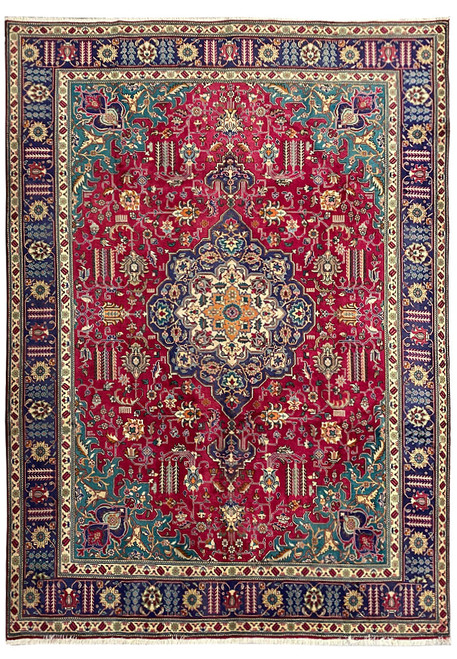
5'9" x 8'9" Sino Tabriz Rug | Dramatic Black & Ivory | Fine Wool & Silk | Star Medallion
Was: $4,390.00Now: $4,120.00 -
-

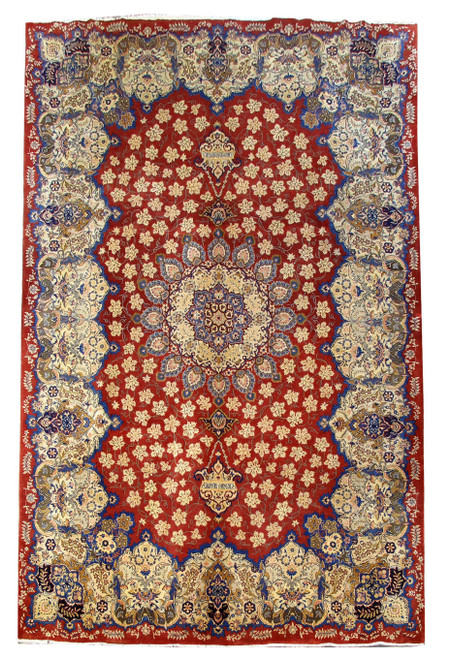
9'9" x 13'2" Persian Tabriz Rug | Red Field, Sky Blue Medallion | 1980s Workshop Weave
Was: $3,890.00Now: $3,699.00 -

6' x 9' Wool and Silk Mahi Fish Tabriz Design Rug | Black Herati Field | Pristine Condition
Was: $4,430.00Now: $4,199.00