Bijar Rugs
Bijar is a Kurdish town in Iranian Kurdistan, and the rugs named after it are the heaviest and densest woven anywhere in Persia. The trade calls them the iron rugs. The name is not marketing: a Bijar of any size is genuinely difficult to handle, stiff enough to resist being rolled, and effectively impossible to fold without damaging it.
Why they are called iron
The density is a construction, not a claim. Bijar weavers pack the weft down with unusual force, working with heavy metal combs and, by long-established account, wetting the weaving so the wool and cotton swell and then dry compressed. The knots end up locked against each other with almost no air between the rows. The consequence is a rug that weighs far more per square foot than its neighbours, has a board-like handle, and will outlive most of the buildings it is put in. A Bijar is the rug to put where the traffic actually is.
The cost of that density
Here is the unhelpful part. A stiff rug is a rug that cannot articulate. Folding a Bijar across itself can crack the foundation along the fold line, and a cracked foundation is a structural injury, not a cosmetic one. They must be rolled, pile outward, around a wide core, and even that is a two-person job in a large size. They do not drape over a stair nose, they do not sit happily over underfloor heating pipes without a proper pad, and they will not settle flat in a week if they have been stored folded. Nothing about this is a defect. It is the same property that makes the rug last, seen from the other side.
Kurdish drawing
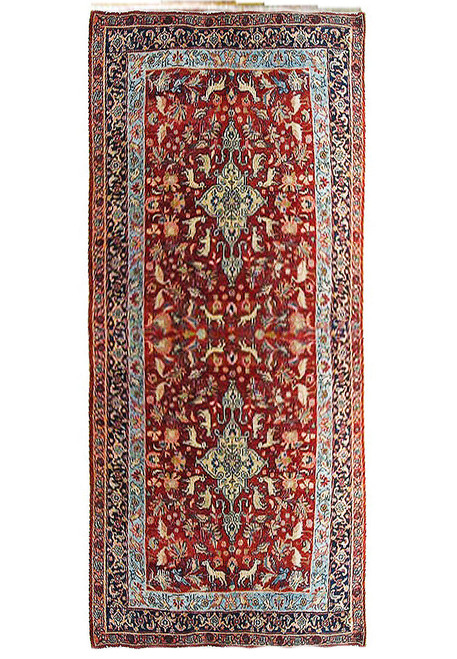
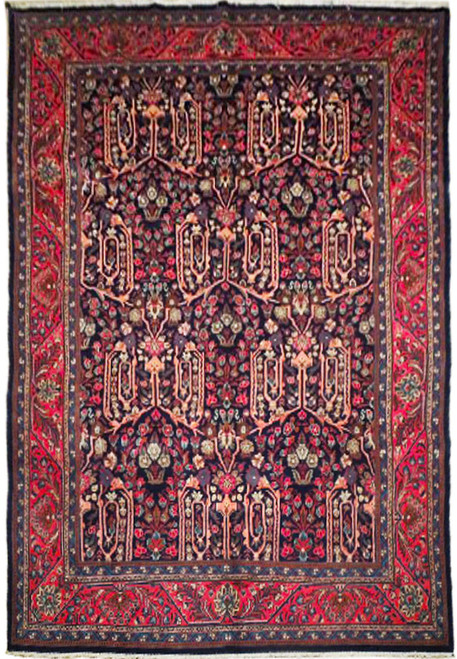
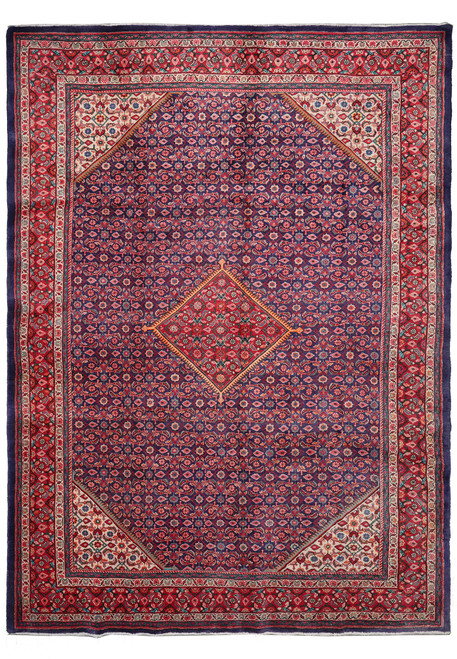
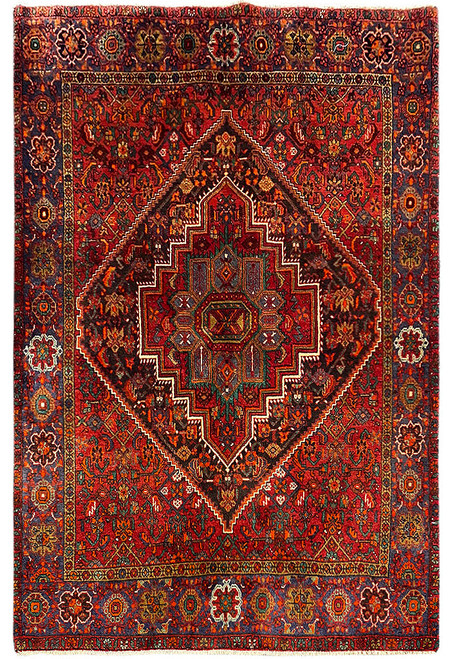
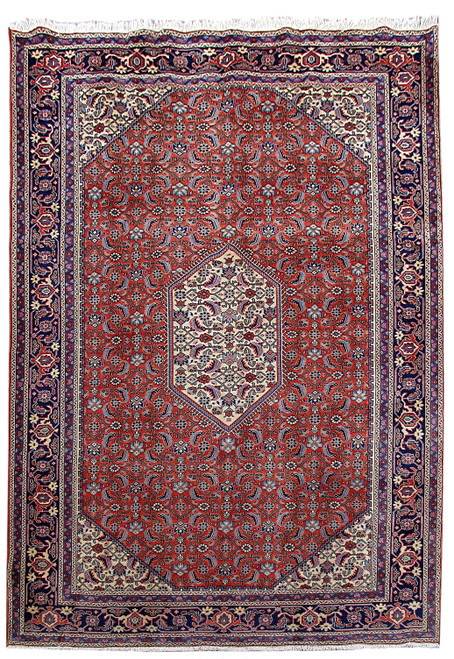
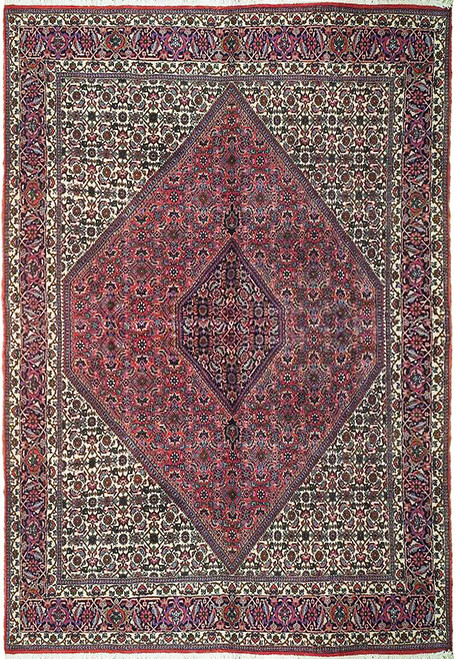
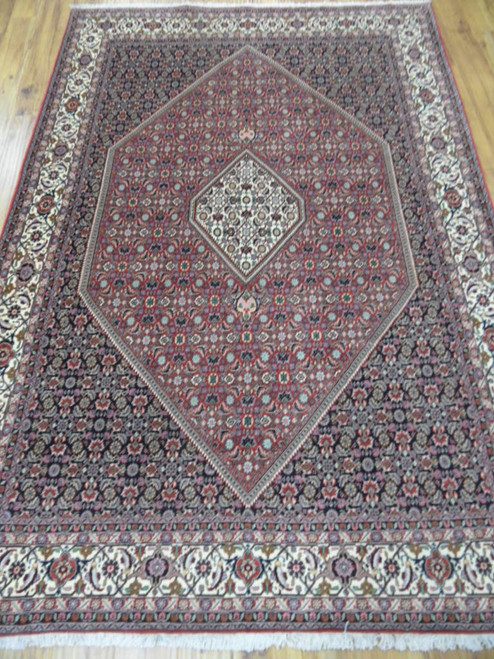
Bijar is Kurdish weaving, and the design sense is neither tribal-loose nor city-tight. The most common field is the Herati repeat, drawn larger and heavier than a Tabriz would draw it, its rosettes and curved leaves sitting like ironwork over the ground. A central medallion with strong corner spandrels is the other standard, and the medallion tends to be a firm, closed shape rather than a spray of cartouches. Some of the best Bijars do something the cities rarely try: an open, almost undecorated field in a single madder red, with the whole design pushed into the border. On a dense pile, that reads as confidence.
Colour and wool
The palette leans hard on madder red and indigo navy, with ivory reserved for outlines and the occasional camel-toned ground. The wool from the region is coarse in the good sense: strong-fibred, high in lanolin, and hard-wearing. It does not take a silky finish and it was never meant to. Older Bijars are frequently woven on a wool foundation rather than cotton, which adds to the weight and to the stiffness, and is one of the things to look for in a pre-1970 piece.
Bijar and Senneh, sixty miles apart
The clearest way to understand a Bijar is to put it next to a Senneh. Both are Kurdish, both use Herati fields, both come from the same province, and the towns are around sixty miles apart. A Senneh is thin, flat, short-piled and light enough to carry under one arm. A Bijar is the same tradition taken in the exact opposite direction. Between them sits Hamadan village weaving, which shares the Kurdish taste for firm geometry without either extreme.
Which rooms
Dining rooms, hallways, entries, anywhere chairs get dragged: this is what a Bijar is for. The pile is too dense to crush and the foundation is too solid to distort under a table leg. Where it is the wrong answer is any room where a rug needs to sit lightly. It will not tuck under a low sofa, it is heavy going in 12x18 formats, and it makes a poor layering rug because nothing lies neatly on top of it. For lightness in a formal room, a Kashan or something in silk is the opposite instrument. Within traditional Persian weaving, Bijar is the one bought for its afterlife.