Chinese Rugs
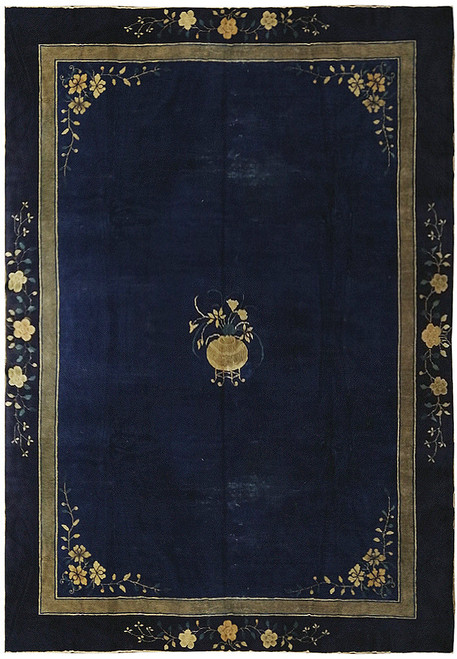
A Chinese rug is the clearest contrast to everything else in this catalogue. Where a Persian field is covered edge to edge, a Chinese one is mostly empty, with a few symbols placed on open ground. It is a different idea of what a carpet is for, and it suits a room that cannot take more pattern.
Space as the design
The central tradition, centred historically on Ningxia and Beijing, treats the ground as part of the composition rather than as something to be filled. A medallion, four corner devices and a wide plain field between them is a complete Chinese design. Next to a Kashan or an Isfahan the difference is immediate: one rug is a garden, the other is a sky.
The symbols, briefly
Chinese rugs carry a vocabulary rather than a botany. Peonies, lotus, bats, cloud bands, the endless knot and the round shou character for long life recur across centuries. They are placed for meaning, which is why they sit apart from each other rather than growing into a continuous vine the way the Herati repeat does.
The carved pile
The other unmistakable Chinese technique is carving: the pile is trimmed lower along the outlines of the pattern so each shape sits slightly proud of the ground. It puts a shadow around every motif and makes the design read from across a room in raking light. It also means the rug looks different at different times of day, which nothing flat-clipped does.
Colour
The historical palette is narrow and cool: indigo blue on ivory, or a soft apricot and gold. Later Art Deco production out of Tianjin widened it considerably and produced the peach, jade and rose carpets that people picture when they hear Chinese rug. Both sit in the ivory and blue families more often than in the red one that dominates Persian weaving.
Construction
Chinese rugs are usually wool on a cotton foundation, knotted at a moderate count with a thicker pile than a workshop Persian rug. The wool tends to be softer and less lustrous. It is a comfortable rug underfoot and a forgiving one to live with, though an open ivory field shows traffic in a way a busy one does not; for a hall, consider a multi-colour field instead.
A note on Tibet and Nepal
Tibetan and Nepalese rugs are often shelved with Chinese ones and are a separate craft entirely: the yarn is looped around a rod and cut, rather than tied, which gives a quite different handle. If the open Chinese field appeals but you want a more contemporary drawing, that is where to look next, along with the modern designs.