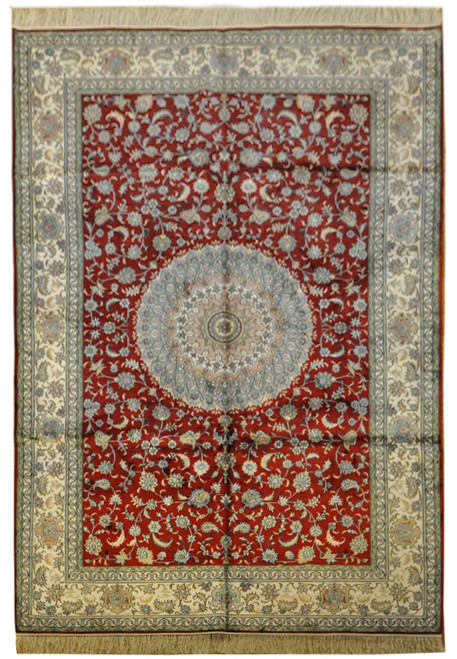
Silk Rugs
Silk is the finest thing woven into a rug and the least suited to being walked on. Both statements are true at once, and the second is the more useful. A silk pile carries drawing that wool cannot hold, changes colour as a person crosses the room, and wears out quickly in the wrong place. Choosing one is mostly a matter of choosing the room.
Strong in tension, weak against grit
A silk filament is very strong when pulled along its length. That is why it can be spun fine and still hold a knot, and why a silk foundation carries more warps to the inch than cotton will. Abrasion is the other story. Grit walked in on a shoe sole works like a file across the top of the pile, and a fine fibre has less material to lose before the knot is cut through. Wool, thicker and scaled, tolerates the same treatment for decades. Silk does not. None of this is a defect. It is a fibre doing what fibres do.
Why the finest knotting is always silk
Fineness is not a virtue in itself. It is drawing room. A knot is a rectangle, and a curve has to be built from a staircase of them, so the smaller the rectangle the closer the staircase comes to a real curve. Silk spins thinner than wool, so more knots fit across the same inch, so the curve arrives. That is the whole argument. Counts are quoted per square inch, or in Tabriz in raj, and the top of either scale is silk territory. It is also why the most finely drawn traditional designs, with their scrolling vine and pictorial medallions, are woven in silk and almost never in coarse wool.
The colour that moves
Silk reflects light directionally. The pile lies one way, so the same rug reads deep and saturated from one end of a room and pale and luminous from the other, and it changes again when a lamp goes on. Turning a silk rug end for end is a decision about colour, not a repair. This is also why photographs of silk are unreliable, and why a Qom seen at midday and the same rug seen at night are hard to accept as one object.
Where the silk actually is
Silk enters a rug in several ways, and they are not the same purchase. All-silk means pile, warp and weft together, so even the fringe is silk. Silk pile on a cotton foundation is common and perfectly sound. Fine wool pile on a silk foundation is a different thing again, an Isfahan speciality, and it behaves underfoot like wool, because the part being walked on is wool. Then there is silk used only to outline a pattern, which is a wool and silk rug and follows another set of rules. Establish which one it is before anything else.
Where it belongs, and where it must not go
Silk belongs where it will be walked on lightly. A bedroom, a study, a formal sitting room, a wall. It is the wrong rug for a hallway. It is equally wrong under a dining table, wrong under castors, wrong in a kitchen, and wrong in a window that takes hard afternoon sun, since silk gives up colour to light faster than wool does. Small formats suit it, so most silk rugs sit in the under four by six and four by six to six by nine bands. If the room takes traffic, the honest answer is not a finer silk rug. It is a wool one, and a Bijar or a Heriz will still be there in fifty years.
Sold as silk, and not silk
Real silk has competition from regenerated cellulose, sold as bamboo silk, art silk, banana silk or plainly as viscose. It shines like silk across a room and is a wholly different material, weaker and far less durable. The bamboo silk page sets out what it is. Mercerised cotton is also used for sheen. The trade separates them by burning a single fibre: silk is a protein, smells of burnt hair and leaves a brittle bead, while cellulose smells of burnt paper and leaves soft ash. The test destroys the fibre, which is why it is done once and deliberately.