Traditional Rugs
A traditional rug was drawn before it was woven. A designer squares the pattern onto paper, one square for each knot, and the weaver works from that sheet row by row. Everything that distinguishes the classical repertoire follows from it: a central medallion, matched corner spandrels, a field of curved floral vinework, a palmette border, and two ends that agree because somebody planned them.
The cartoon, and the two people who make the rug
The design sheet is the whole difference. It is drawn and coloured square by square, then hung above the loom or passed along the bench, and a weaver reads it the way a musician reads a part. One sheet serves many rugs, which is why two examples of the same workshop design are near identical and why a lost or damaged rug of this kind can be rewoven decades later. It also means the person who invented the pattern and the person who tied the knots are usually not the same person, and neither is anonymous by accident: the drawing is a specialism with its own apprenticeship.
Reading the layout
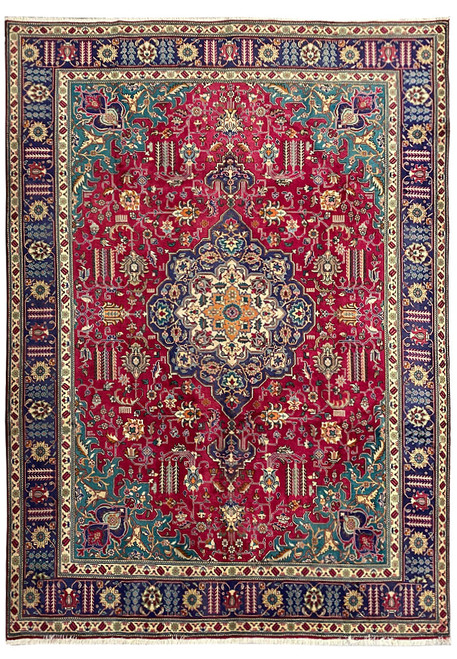
The standard arrangement has a name in the trade, lachak toranj, after its two parts. The toranj is the central medallion, often with a pendant hanging from each end. The lachak are the four corner spandrels, which repeat a quarter of the medallion's drawing so the eye reads them as pieces of the same shape cut off by the field's edge. Around that sits a main border, almost always with narrower guard stripes on both sides of it. Everything is symmetrical on at least one axis. The alternative is an all-over field with no medallion at all, the same vinework running edge to edge, which the trade simply calls all-over.
Why a curve costs knots
A knot is a small rectangle, slightly wider than it is tall. A straight line along the warp or the weft is free. Anything else has to be approximated by a staircase of rectangles, and the only way to make that staircase invisible is to make the rectangles smaller. That is the entire economic argument for fineness in this family: a fine rug is not more durable than a coarse one, it simply has more drawing room. It is why Tabriz quotes raj, why curved acanthus and naturalistic flower heads belong to the fine end, and why a coarse rug in the same tradition sensibly draws its ornament straight-sided instead of pretending.
The fields that keep coming back
Four patterns account for a great deal of the repertoire. The Herati repeat, a rosette in a diamond with four curved leaves around it, turns up in more traditional rugs than anything else. The shah abbasi palmette, a large fan-shaped bloom seen in section, is the usual border motif and often the field motif too. The boteh, the teardrop with the bent tip, runs in rows across whole fields. And the vase and the tree of life stand upright, which makes those rugs directional: they have a top, and they look wrong from the other end of the room.
Where the family is anchored
The Persian reference points are Kashan for the medallion drawn with authority, Isfahan and Nain for fine curved work on ivory and blue grounds, Qom for the same discipline in silk, Sarouk for a heavy floral field on red, Kerman for softer palettes and Moud for the fine all-over Herati. The same repertoire is woven honestly outside Iran: a great deal of Indian and Pakistani production is classical Persian drawing, and a Heriz works from a cartoon as well, even though its angular drawing makes it read as village work. The line between this family and tribal weaving is drawn by method, not by how geometric the result looks, and plenty of rugs sit awkwardly across it.
When not to buy one
Two situations. A room that already carries pattern in its curtains and upholstery cannot take a full classical field as well, and the usual result is that neither wins; a transitional piece is the better answer there. And a medallion rug wants to be seen whole. Put a sofa across one end and a coffee table in the middle and the design is half hidden, with the part that cost the most now under furniture. In a room like that, choose an all-over field instead, which survives being covered because it has no centre to lose. Fine pile with silk outlining is also the wrong surface for a corridor: grit cuts short, dense pile faster than it cuts a coarse one.
-

8'4" x 11'8" Persian Kashan Rug | Red Field, Ivory Medallion | Classic Workshop Floral Design
Was: $3,840.00Now: $3,450.00 -

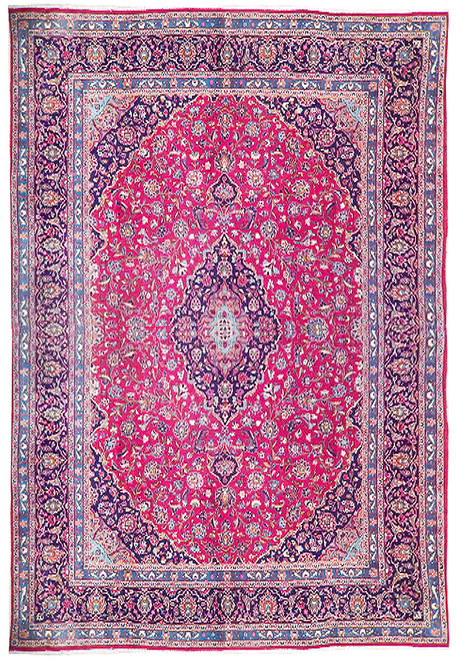
9'8" x 12'10" Persian Mashad Rug | Opulent Berry Red & Navy Blue | Hand-Knotted Elegance
Was: $3,750.00Now: $3,200.00 -

5'9" x 8'9" Sino Tabriz Rug | Dramatic Black & Ivory | Fine Wool & Silk | Star Medallion
Was: $4,390.00Now: $4,120.00 -

9'8" x 12'8" 9'9" x 12'10" Persian Mashad Rug | Crimson Red Floral Elegance | Semi-Antique | Excellent Condition
Was: $3,350.00Now: $3,200.00 -

9'5" x 11'11" Ziegler Area Rug | Golden Beige Floral Motif | All-Over | Agra Design
Was: $3,900.00Now: $3,660.00 -
-
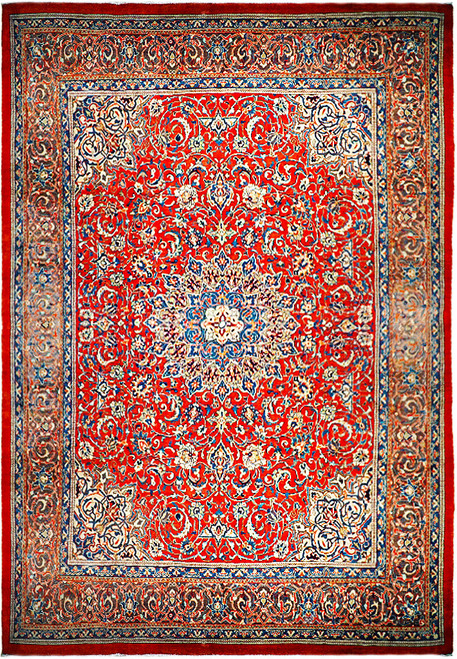
9'11" x 13'6" Persian Sarouk Rug | Sheikh Safi Inspired | Star Medallion | Red Orange & Ivory Wool
Was: $3,550.00Now: $3,399.00 -

-

-
-

-
