Heriz Rugs
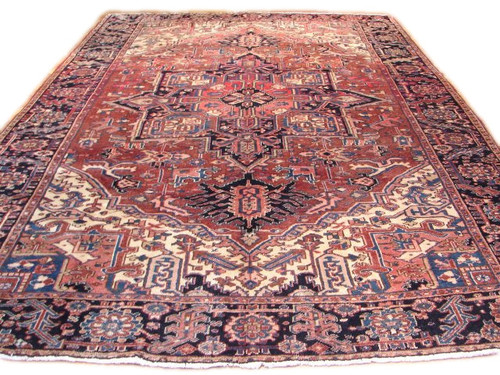
Heriz is a district of villages east of Tabriz, in Iranian Azerbaijan, and it weaves the opposite of a city rug. The knot is coarse, the pile is thick, the foundation is heavy cotton, and the design is a large angular medallion sitting on a rust red ground. Nothing about it is delicate. That is precisely why a Heriz outlasts most of the furniture put on it.
Coarse on purpose
A Heriz is knotted with the symmetric knot on a cotton warp and cotton weft, at a density the trade politely calls moderate and everyone else calls coarse. The knot count sits well below anything a workshop city would accept, and the pile is left long. Those two facts together are the whole argument for the type. A thick pile has material to lose before the foundation is reached, and a coarse knot on a heavy cotton base is structurally hard to hurt. Set next to a fine rug from Isfahan or Tabriz, a Heriz looks blunt. Set on a floor that people actually use, it wins.
Why the medallion is that big
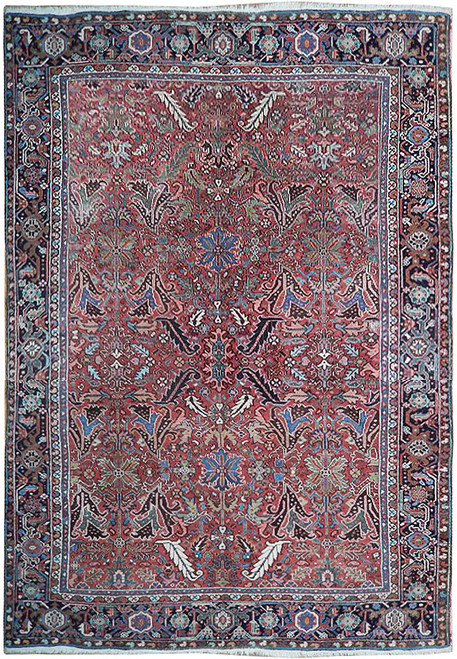
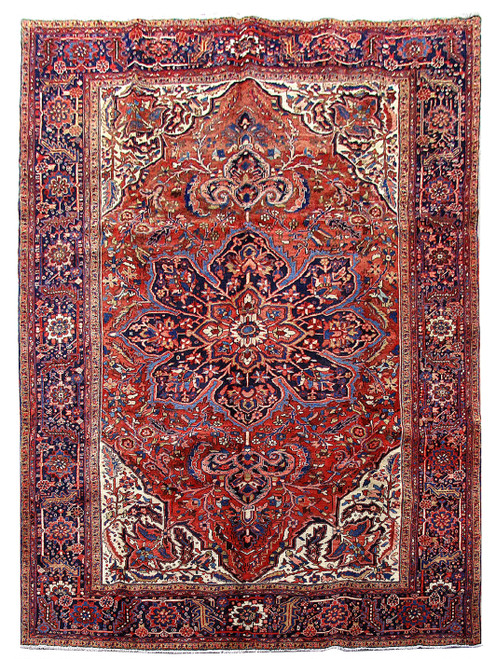
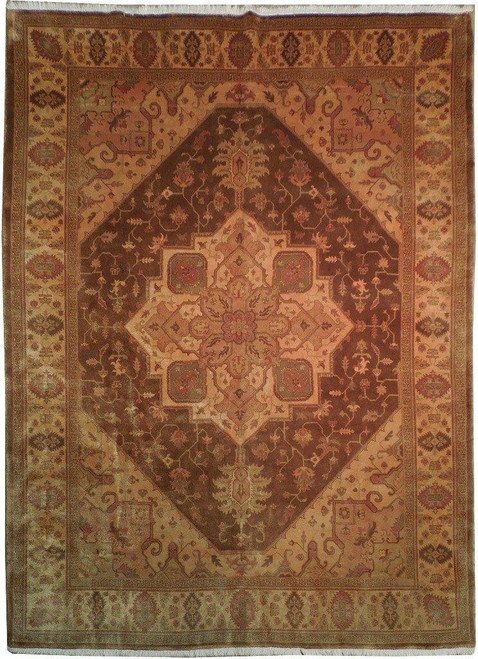
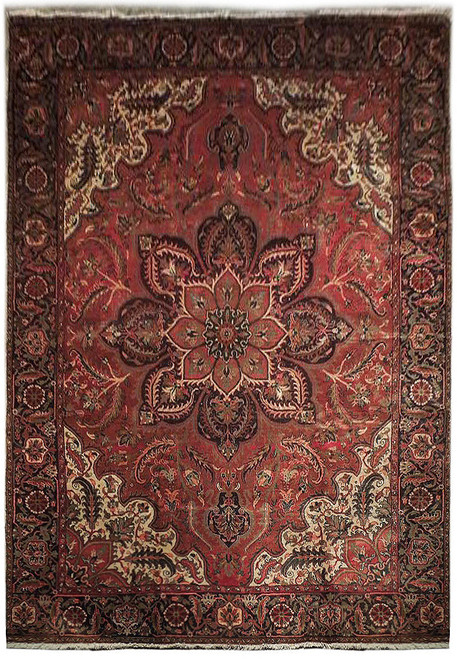
The standard field is one large medallion with heavy stepped edges, broad spandrels filling the four corners, and stylised leaves and vine covering whatever ground is left. It is drawn on the grid rather than against it: every curve resolves into short straight runs, because at this knot count a smooth curve is not available and the village designers never pretended otherwise. The scale follows from that. A small motif would turn to mush at this density, so the drawing is enlarged until each element survives on its own. That is what separates Heriz from the curvilinear city styles and puts it closer, in spirit if not in geography, to the geometric weaving of Ardebil and the Kazak tradition across the border.
Rust, navy, ivory
The palette is nearly fixed. A terracotta or rust field, a navy medallion, ivory corners, with dull gold, soft green and madder red doing the detail work. Abrash, the horizontal banding that appears when one dye lot runs out and the next is not quite identical, is common here and is not a fault. On a field this large it reads as movement. What the palette will not do is stay quiet. A Heriz is a warm, high-contrast object, and it sets the temperature of a room rather than agreeing with one.
The wool, and the story about the water
The wool from the district is genuinely good: long in the fibre, high in lanolin, and it takes on a low sheen with use instead of going dull. The trade has long explained this by saying the local water carries copper, which toughens the fleece. Treat that as workshop lore rather than as established fact. What is established is how the finished rug behaves. The pile compacts instead of shedding, worn areas even out instead of going patchy, and a hundred-year-old Heriz with a low pile is usually still sound underneath. A pre-1970 piece that has been walked on for decades is often the better buy rather than the worse one.
Sizes the district was built for
Heriz weaving grew up with the export trade, and the export trade wanted carpets for rooms. That is why the district is one of the most reliable sources of eight by ten to ten by fourteen rugs and of genuinely 12x18 pieces, and it is why the cotton foundation matters: cotton does not stretch, so a very large Heriz comes off the loom flat and stays square. The same design in an accent size is a weaker proposition. Shrink a medallion built for a drawing room down to a small rug and the corner spandrels crowd the centre.
What a Heriz will not do
It will not give you fine detail, so anyone who wants drawn curves and small pattern should be looking at a city weave instead. It will not sit politely under a low sofa, because the pile is thick and the handle is stiff. It will not disappear into a pale interior. And an open medallion field shows a walked path more readily than an all-over repeat does, so a busy corridor is better served by a pattern with nowhere for the eye to rest. For sheer density in a punished room the Kurdish Bijar is heavier still. For the finer, older and more open end of this same district, the trade grade to look at is Serapi. Within Persian weaving as a whole, Heriz remains the default answer for a room that gets used.