Kazak Rugs
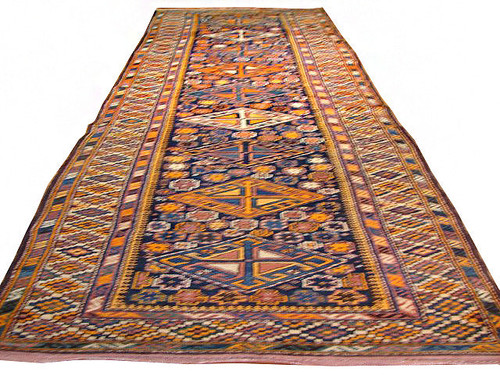
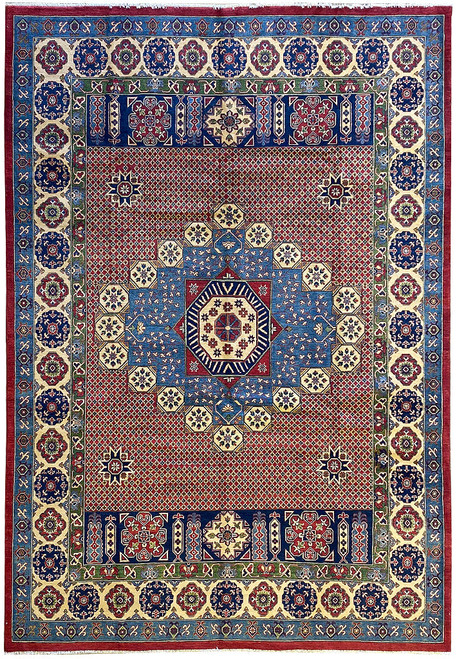
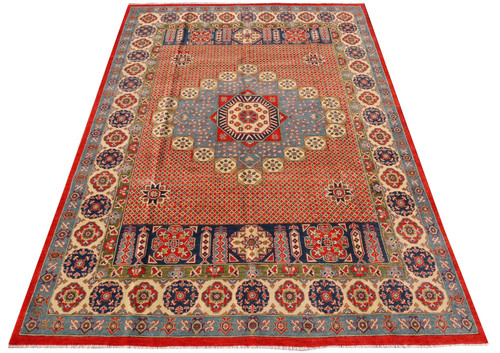
Kazak is a district in the southern Caucasus and a way of drawing that carries across a room. Two or three very large devices, set on a red or an ivory ground, in a handful of colours used at full strength. The pile is long and lustrous, the knot is coarse, and nothing in the design is subtle. Most rugs sold as Kazak now were woven somewhere else entirely.
Four colours, none of them held back
Count the colours in an old Kazak and the number is usually four or five. Madder red, indigo blue, undyed ivory, a yellow, and often a green made by dyeing yellow over indigo. Six is a crowded Kazak. What makes the effect is not the number but the handling: each colour sits in a large unbroken block, with no shading, no half tones and no transitional outline to soften the join. A city workshop dissolves colour into scrolling vine so that no single area dominates. Kazak weaving does the opposite. It puts a red field next to an ivory medallion and lets the two argue.
A coarse knot under a long pile
These are symmetrical knots, the kind also called the Turkish knot and shared with most Anatolian weaving, tied at a low count on a wool warp and wool weft in older pieces. The pile is then left long. Coarse knotting under a long pile means outlines fur very slightly, so fine drawing is not available and the design never attempts it. Everything is built at a size that survives the technique: stepped medallions, hooked bars, squared latch-hooks, eight-pointed stars, animals reduced to five or six straight lines. The wool from these highlands is long-fibred and high in lanolin, which is where the sheen comes from, and it is the reason a hundred-year-old Kazak with half its pile gone still looks alive rather than bald.
The names inside the name
The trade sorts antique Caucasian weaving into district names, and Kazak is one of several alongside Karabagh, Shirvan, Kuba and Gendje. Within Kazak there is a second layer of names, Lori Pambak, Fachralo, Bordjalou, Sevan and Karachov among them, each attached to a recognisable layout rather than to a documented village. Treat them as design groups, because that is what they reliably are. The looser family resemblance is with village weaving generally, and the nearest Persian cousin is Ardebil, just over the border and drawing from the same vocabulary.
Where new Kazaks come from
This needs saying plainly. Very little Kazak weaving happens in the Caucasus today. The great majority of new rugs sold under the name are woven in Pakistan and Afghanistan, on the same looms and often by the same weavers who produce Chobi rugs, working from Caucasian drawings. The good ones are handsome, handspun and honestly made, and they are reproductions. What they are not is old Caucasian weaving, and the two should never be confused on price or on wool. An antique piece is a pre-1970 question and a different market.
Small by tradition
Old Kazaks are mostly small. The looms were narrow and the weaving was domestic, so the standard formats are scatter sizes, four by six to six by nine pieces, and the long narrow rug that sits between a scatter and a runner. A genuinely large antique Kazak is rare enough that any very big one deserves a second look at the weave. Modern reproductions are made in every size including room-filling ones, which is worth knowing before the size chart does the talking.
What a Kazak is bad at
It will not recede. A Kazak is the loudest object in any room it occupies, and it cannot be asked to play background to patterned upholstery or a busy wall. The second problem is scale. Two enormous medallions need floor around them to be read, so a Kazak buried under a dining table and eight chairs spends its life showing nothing but border. For that job take an all-over field with no centre, a Bokhara repeat or a Herati one, where furniture can land anywhere without cutting the design in half. Where a Kazak is exactly right is a plain room with an empty middle, which is the room most people actually have.