Kerman Rugs
Kerman, in the south east of Iran, has the longest unbroken record of fine weaving in southern Persia, and for more than a century it wove largely for export. The drawing is curvilinear and botanical, built on arabesque scrollwork rather than geometry, and the palette is the one genuinely pale register in Persian weaving: rose, ivory, celadon, dove blue and soft gold.
Four centuries of the same trade
Kerman was weaving carpets for the Safavid court and for export in the seventeenth century and has effectively never stopped. The group known as the vase carpets, and the related shrub carpets, are generally attributed to Kerman and are among the most technically ambitious floor weavings ever made in Persia. They are almost all in museums now, so this is history rather than a shopping category, but it matters: it means Kerman designers have had a continuous professional tradition to draw on, which shows in the confidence of the drawing. Only Tabriz and Kashan have comparable continuity, and both are northern.
Drawn, not remembered
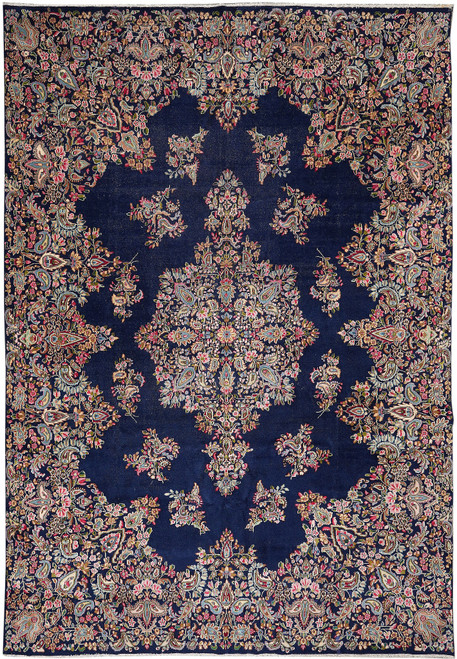
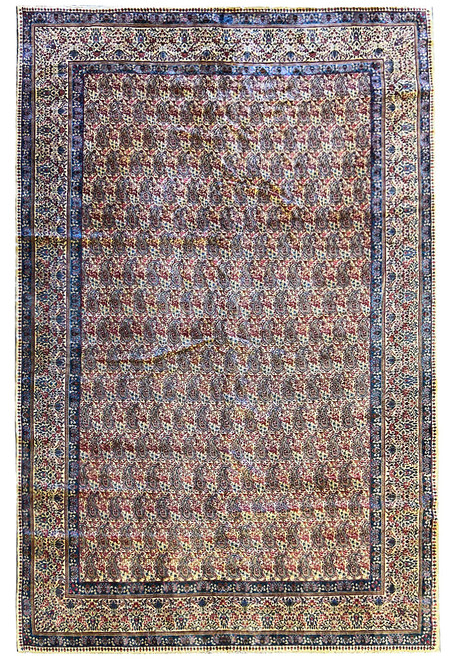
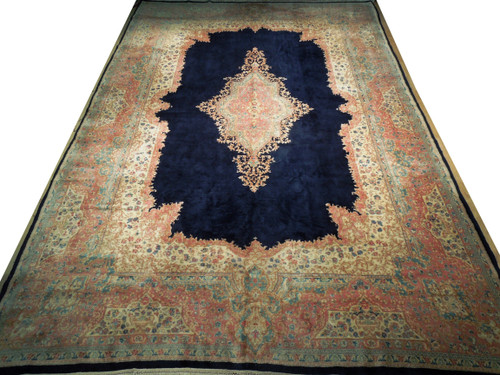
A Kerman is a designed rug. The compositions are curvilinear: a central medallion with elaborate corner pieces on an open ground, all-over floral fields, a tree of life, a vase of flowers, a garden layout, or a pictorial panel. What distinguishes them from other city work is the botanical specificity. Kerman flowers are recognisable as roses and lilies rather than as generalised rosettes, and they are held together by fine arabesque scrollwork that keeps moving across the field. Fine detail requires fine knotting, and Kerman knots with the asymmetric Persian knot on a cotton foundation, usually with several wefts between rows, which is what gives the back its characteristic ribbed feel. If you want geometry instead, the Afshar weavers a short way south were doing the same flowers in straight lines.
The pastel question
Persian weaving is mostly built on madder red and indigo. Kerman is the exception. Its dyers worked a range that includes true pale tones: rose and old pink, ivory and cream, celadon and sage, dove blue, pale gold and a soft grey green. Kerman also produces deep madder and ink blue rugs, so the pale palette is a speciality rather than a rule, but it is the reason these rugs turn up in interiors where nothing else Persian will go. If the room needs pink and rose, ivory, green or soft gold rather than a strong field colour, Kerman is the first Persian name to try, and the closest comparison outside Persia is the flat woven pastel tradition of French Aubusson.
Lavar, and other words for fine
The trade calls the finest older Kermans Lavar or Laver, a corruption of Ravar, a town north of the city. The name properly meant a place and now functions mainly as a grade: when a dealer says Lavar Kerman he means very fine, closely drawn and probably late nineteenth or early twentieth century. Treat it as a claim about quality that you should verify with your eyes rather than as documented provenance. Much of the enormous American export production of the 1920s to 1950s is also Kerman, in large sizes and soft colours, and those rugs are now solidly in vintage territory.
Living with a pale ground
The obvious warning is the true one. An ivory or rose Kerman shows what walks on it. The pile is typically clipped fairly short, which is good for holding fine drawing and less good at hiding traffic, and a pale open field has nowhere for dirt to hide. This is a rug for a formal sitting room, a bedroom or a dining room with a hard-floor route to it, not for the corridor from the back door. A Kerman will last decades in the right room, since the wool is good and the construction is sound, but it is honest to say the right room is not every room. For traffic, a heavier northern weave such as a Bijar or a Heriz will take abuse that a Kerman should not be asked to.
Sizes
Because Kerman wove for export it wove big. This is one of the few Persian names with a reliable supply of large and 12x18 carpets in a fine, curvilinear, traditional design, along with medium pieces, runners and round formats made for specific rooms. The medallion compositions in particular want space around them, so a Kerman that is too small for its room loses the thing it was drawn to do. For a large floor where the pattern needs to run under furniture instead of being centred, an all-over Khorasan design such as a Moud is the better structural choice.