Serapi Rugs
Serapi is a grade, not a place. No village of that name ever wove a rug. The word is used in the trade for the finest, oldest and most openly drawn carpets from the Heriz district of north-west Iran, and it is applied after the fact by the people selling them. Knowing that is the difference between buying a carpet and buying a word.
Where the word comes from
The name is generally traced to Serab, a town in the same corner of Iranian Azerbaijan, and it reached the western trade through nineteenth century dealers rather than through the weavers themselves. Whatever its origin, the working meaning drifted long ago. Serapi now describes not where a carpet was made but what a carpet is like: finer in the knot than the run of Heriz weaving, older, with more space around the drawing and a softer palette. All Serapis are Heriz-district carpets. Very few Heriz-district carpets are Serapis.
The three grades
Dealers have long sorted the district's output into a rough ladder. Gorevan sits at the coarse end, plain Heriz in the middle, Serapi at the top. It is a commercial sorting rather than a map, and there is no fixed knot count at which one becomes another. Different dealers draw the line in different places, and the same carpet can honestly be called two different grades by two different people. Treat the ladder as a description of quality inside one tradition, and treat the boundaries as soft, because they are.
What a good one looks like
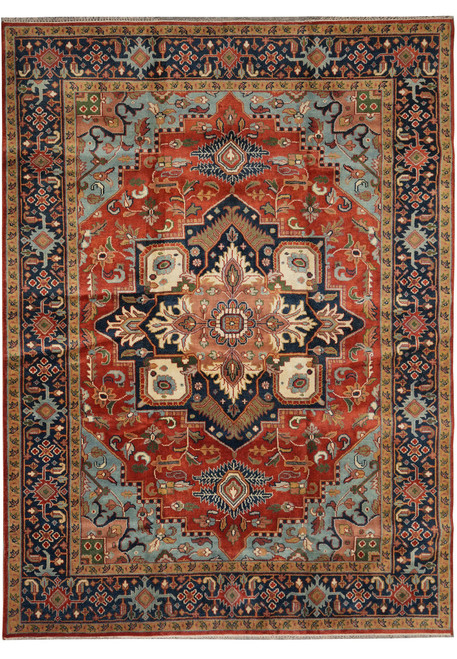
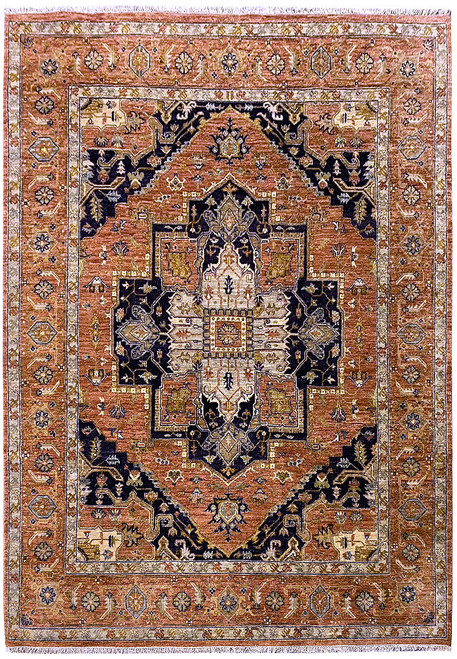
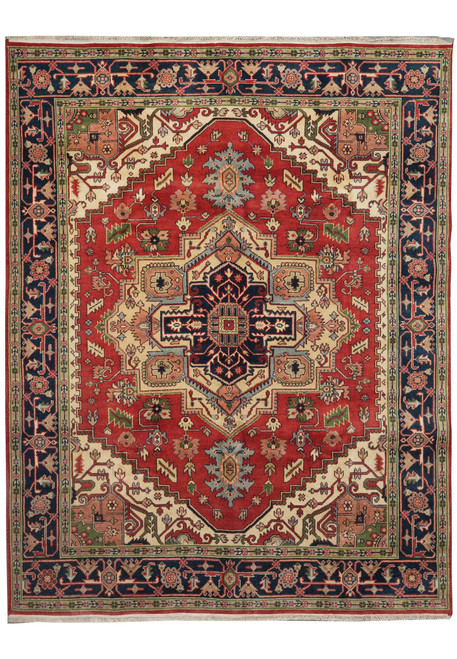
The traits that make a Heriz-district carpet read as Serapi are consistent enough to list. The field is more open, with ground visible around the motifs instead of packed with vine. The medallion is often smaller in proportion to the field, or missing entirely, leaving an all-over drawing. The palette is softer: rust and terracotta thinned toward apricot, ivory used generously, blues that have gone grey with age rather than staying hard navy. The pile is usually lower, the handle lighter, and the wool carries the sheen that only decades of use produce. Most of what deserves the name was woven before the First World War, which puts a real one well inside the pre-1970 group and a long way past it.
The modern ones
Serapi has been a desirable word for a hundred years, so the look is now produced deliberately. New rugs in the Serapi manner are woven in India, Pakistan and Afghanistan, usually with handspun wool and plant dyes, and usually washed to soften the colour before they are sold. Some of them are very good rugs. They are not antique Heriz-district carpets, and the honest way to describe them is as a design, in the same way that Ziegler and Chobi now name designs rather than single workshops. The difference shows on the back, in the wool, and in how the colours sit against each other. Age softens a palette in a way that a chemical wash approximates but does not reproduce.
Buying a grade honestly
Because Serapi is a word applied by a seller, the name on its own proves nothing. Look at the carpet instead. Is the field genuinely open, or is it a standard Heriz layout being talked up? Is the knot visibly finer on the back? Has the palette softened through use or through chemistry? None of this makes a plain Heriz a worse purchase. A good Heriz described as a Heriz is a better thing to own than a Heriz described as something else.
Where one belongs
An antique Serapi has a lower pile than a working Heriz, which makes it less of a brute and more of a furnishing. It still takes traffic, because the foundation is the same heavy cotton, but a carpet with most of its pile already behind it wants a drawing room rather than a front hall, and it is the wrong choice under a dining table. The scale suits large and 12x18 rooms, which is what the district wove for in the first place. Against the rest of Persian weaving, this is the geometric tradition at its most relaxed.