French & Aubusson Rugs
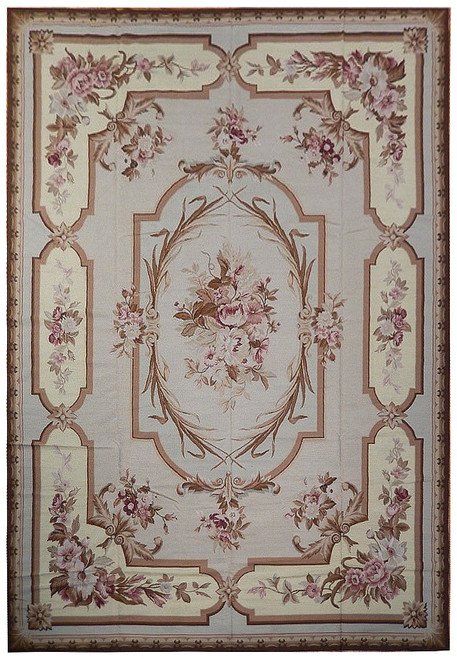
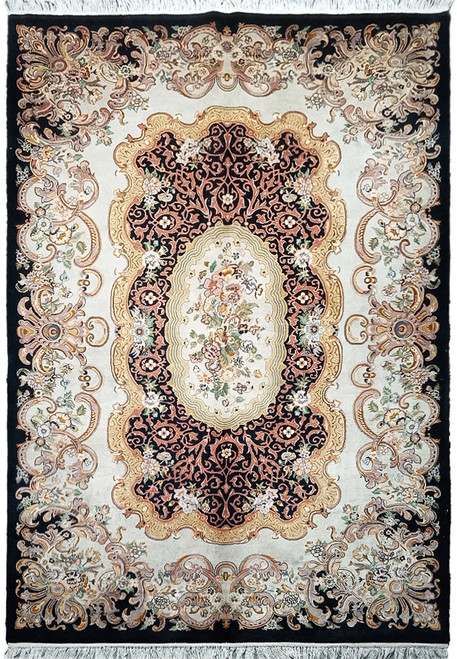
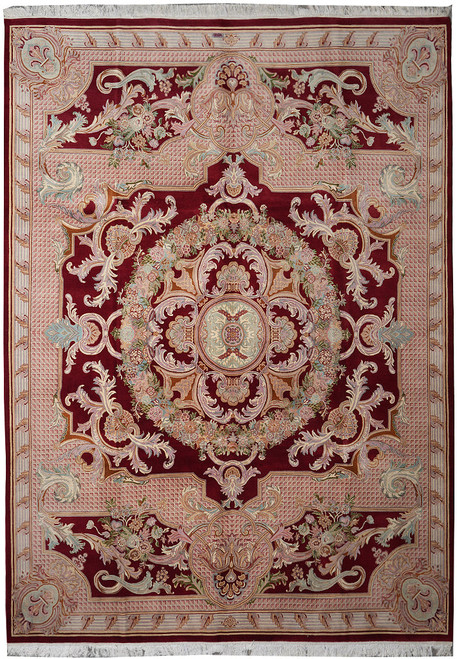
An Aubusson is a tapestry, woven flat, with no pile on it at all. The technique belongs to the workshops of Aubusson in central France, which wove wall hangings first and carpets later, through the eighteenth and nineteenth centuries. The surface is smooth wool, the drawing is French room decoration: a rosette medallion, acanthus scroll, garlands and ribbon, in colours that were pale from the start.
No pile, and everything that follows
In a knotted rug the pattern stands above the foundation in tufts of wool. In an Aubusson the pattern is the weft itself, packed tight across the warps so that nothing sits above the structure. The rug is thin, light, and folds like heavy cloth. That puts it with flat weaves technically, though it has nothing else in common with a tribal kilim. Everything else about living with one follows from the missing pile: no cushioning, no sound absorption, no warmth underfoot, and no sacrificial layer. A knotted rug can lose half its pile over a century and still be a rug. An Aubusson that wears through its wefts has a hole, and a hole in a tapestry is a rebuild, not a trim.
Savonnerie, the knotted opposite
The other French carpet name is Savonnerie, and the pair is often confused because the taste behind them is the same. Savonnerie was the royal knotted-pile manufactory, founded in the seventeenth century in a former soap works outside Paris and later absorbed into the Gobelins works. Same court vocabulary, opposite construction: deep pile, heavy, grand, made for palace rooms. So asking whether a rug is Aubusson or Savonnerie is a question about how it was built, not about how it was drawn. Both sit under European weaving, which is a small category next to the eastern ones and an unusually formal one.
The drawing
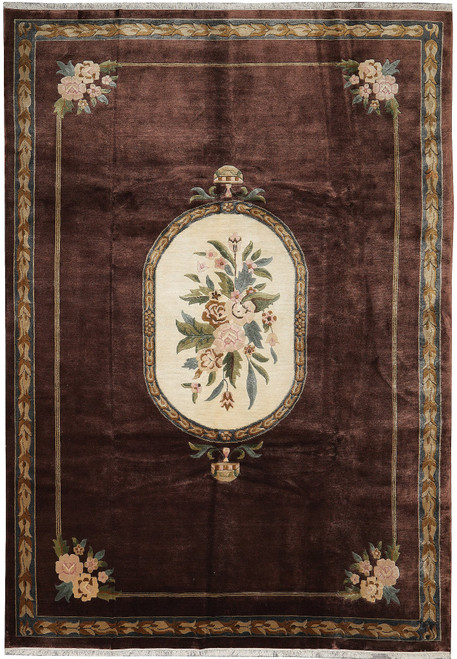
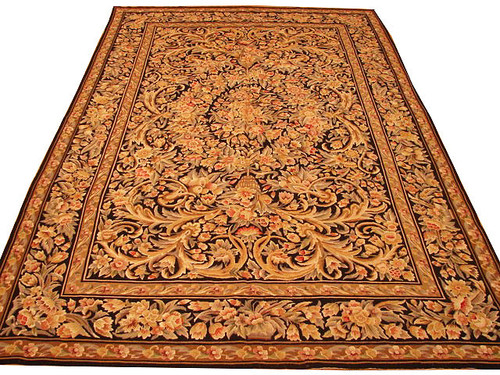
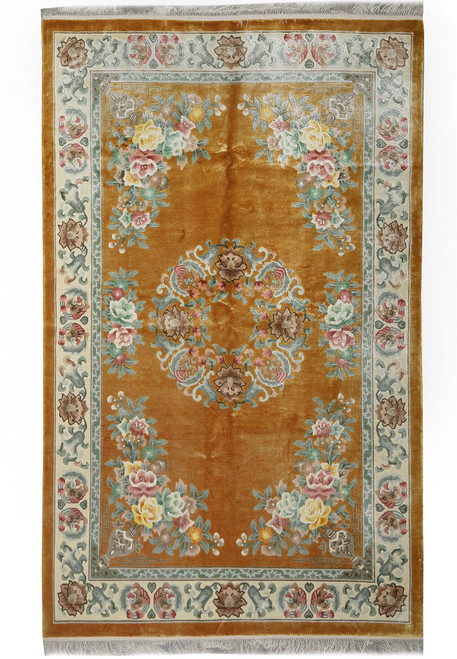
The repertory is eighteenth and nineteenth century French decoration, following the fashions of the rooms it was made for: Louis XV asymmetry, Louis XVI order, the military motifs of the Empire, and the heavier floral taste of the Second Empire after it. A central rosette in a round or oval reserve, acanthus scrolling out from it, garlands of naturalistic flowers, ribbon bows and shaded cartouches. Much of it is drawn in trompe l'oeil, shaded so that a completely flat surface appears modelled. The palette runs to cream, faded rose, celadon green, soft gold and pale blue on an ivory ground, and it was pale when new, not merely faded into pastel.
Slits, and where to look at an old one
Tapestry weaving leaves a slit wherever two colours meet along a vertical line, because the two wefts turn back at the same warp without crossing. Aubusson weavers handled this by interlocking the wefts or by sewing the slits closed afterwards. On an antique piece those seams are the first place to check, along with the edges, since a flat weave has no pile to disguise a repair. Condition matters more here than in almost any other traditional rug, and a pre-1970 example should be read carefully rather than romantically.
Woven now, and where
The design has been reproduced continuously for a century. Most Aubusson-pattern rugs available today are woven in China and India, some in the original flat tapestry technique and some as knotted wool pile carrying the same drawing. The pile versions are a different object: thicker, softer, far more durable, and not an Aubusson in any structural sense. Both are sold under the name, so the first question about any of them is whether it has a pile.
Why it is the wrong rug for a hallway
A corridor concentrates every footfall into the same narrow line. On a pile rug that line crushes and recovers. On a tapestry it abrades the weft directly, and the abrasion goes straight into the structure. Heels and chair legs catch on a flat surface, the rug creeps without a proper pad under it, and a pale ground records the traffic while it does so. Aubussons belong in a formal sitting room, a bedroom, under a low table where nobody walks, or on a wall, which is where the technique started. For a hall or a runner position take a dense pile instead: a Bijar is built for exactly the job an Aubusson cannot do.