Turkish Rugs
Turkish weaving uses a different knot from Persian weaving, and it changes everything downstream. The symmetric knot grips both warps and sits square, which makes it superb at a straight line and awkward at a curve. Anatolian design followed the knot: geometry, angles, and a pattern built from shapes rather than from vines.
The knot, and what follows from it
The symmetric knot, often called the Turkish or Ghiordes knot, loops around two warps and is pulled down between them. It is a stable, hard-wearing knot that produces a slightly thicker pile per row than the asymmetric knot used across most of Iran. Drawing a smooth curve on it takes a very high count, so Anatolian weavers mostly did not try, and built their fields from medallions, hooks, stars and stepped outlines instead.
Oushak, the export name
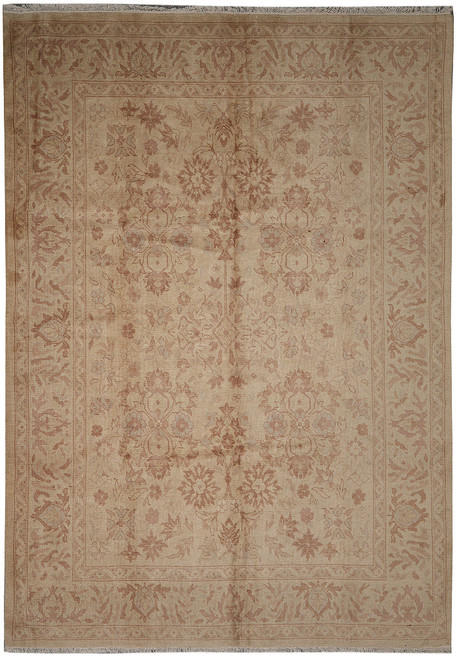
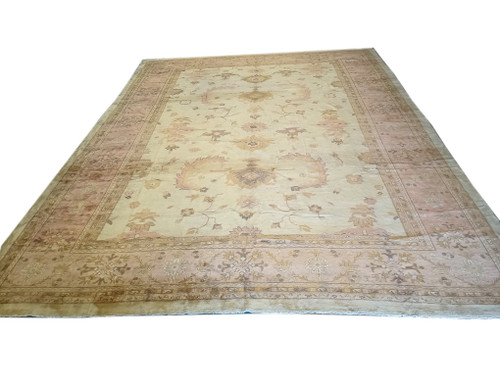
The Oushak is the Turkish rug most people have seen, and its identity is colour before pattern: soft apricot, terracotta, pale gold and a particular grey-blue, on a large open field with a loosely drawn medallion. Woven coarse and with a long pile, it was made for export to Europe from the fifteenth century onward and it is still the easiest antique-looking rug to place in a modern room.
Prayer rugs
A large part of Anatolian weaving is the prayer rug, identified by the mihrab: a pointed arch at one end of the field, pointing the way a person kneels. It makes the rug directional in a way almost nothing else here is, and it means the design is meant to be read from one end only. Many carry a hanging lamp inside the arch and a pair of columns at the sides.
Colour
Anatolian dyers worked with madder for red, indigo for blue, weld and vine leaf for yellow, and the local wool is lustrous enough that the colours stay bright. Turkish reds tend warmer and more orange than Persian ones, and the rust and orange family holds a good share of the tradition, with the rest in red and ivory.
Neighbours
The closest relatives are north and east. Caucasian weaving uses the same knot and pushes the geometry further into pure heraldry, with the Kazak as its clearest type. Turkish designs are also widely rewoven today in India and Pakistan, honestly sold as such, and that is where most new Oushaks come from.
Living with one
A long-pile Oushak in wool is a comfortable rug and a forgiving one, and its open field suits a room with a lot going on. It is not a good choice under a dining table, where a longer pile catches everything; for that take a shorter, denser weave. The size bands matter more than usual here, because an Oushak's open field looks wrong if the rug is too small for the seating.