Transitional Rugs
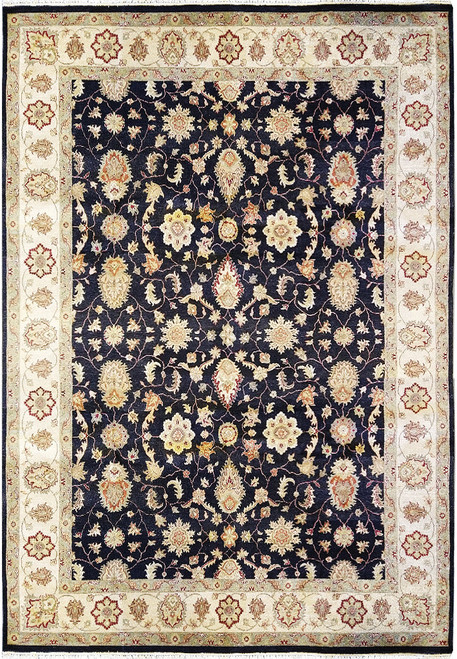
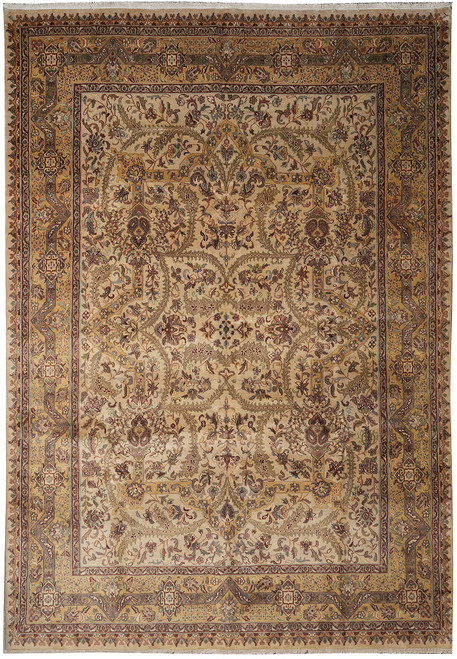
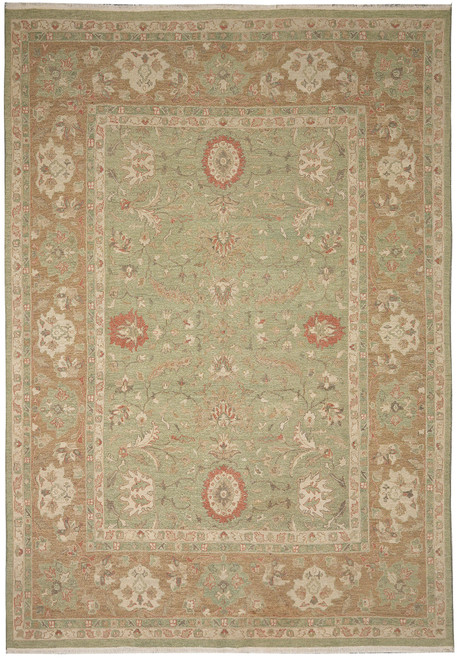
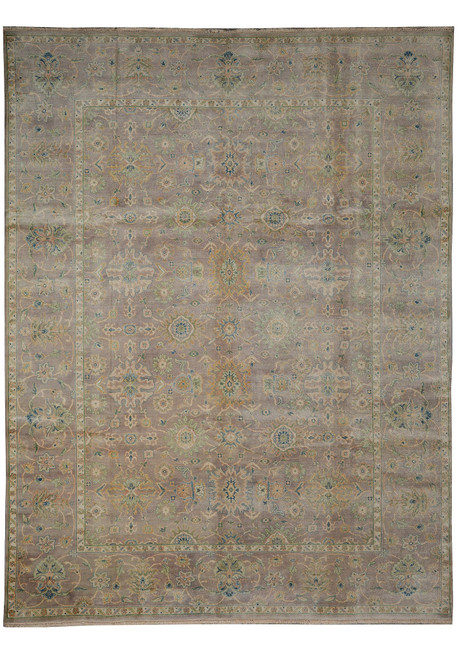
Transitional is the trade's word for a classical rug with most of it taken out. The structure survives: a medallion, a border, a field with a sense of direction. The density does not. One band of border instead of four, three or four colours instead of twelve, and a great deal of ground left doing nothing at all. It is the easiest hand-knotted rug to put in a room that already has pattern in it.
Subtraction, not invention
Nothing here is new. Take a traditional layout, remove the guard stripes, drop the corner spandrels or leave them as a faint echo, enlarge the remaining motifs so there are fewer of them, and reduce the palette until two colours are doing the work and the rest are accents. What is left still reads as an old rug from across a room, because the bones are the old bones. Close up it reads as an open field with some drawing in it. That gap between the two readings is the whole effect, and it is also why photographs of these rugs are unreliable: the pattern is quieter in a room than on a screen.
The Ziegler idea, and where it came from
This is not a modern invention either. In the late nineteenth century the Manchester firm of Ziegler and Company set up production around Sultanabad in central Persia, weaving for European and American interiors rather than for local use. The drawing was deliberately opened out and the colours softened, because the rugs had to sit under heavy furniture in rooms that were already busy. Those pieces are the ancestor of everything in this category, and the name survived the firm: a rug sold today as a Ziegler is a revival, woven for the most part in Pakistan and Afghanistan, with hand-spun wool and natural dyes.
Oushak, the other source
The second ancestor is western Anatolian. Oushak weaving works at a large scale with loosely drawn floral and medallion designs, a long shaggy pile and a palette built on apricot, soft gold, pale blue and terracotta. It was never a fine tradition and never tried to be, which is exactly why it suits this family: the drawing was already generous and simplified before anyone thought of the word transitional. Turkish weaving generally sits closer to this register than Persian weaving does, and the wider Turkish vocabulary is where most of the current revivals go looking.
Three or four colours
The restricted palette is doing more work than the drawing. Natural dyes on hand-spun yarn give a colour that varies slightly along the thread, so a field of one dye is never flat, and the horizontal banding of abrash is often left in on purpose rather than hidden. The usual ranges are ivory and beige, soft brown and camel, muted green and a grey-blue. The chobi weaving of Afghanistan and Pakistan is built on exactly this idea, and a great deal of it is sold under one of the two revival names above.
The room it actually solves
A room with patterned upholstery, wallpaper, books and art already has enough going on, and a full classical field competes with all of it. A transitional rug gives the floor a hand-knotted surface without adding another argument. It also scales up well: because the motifs are large and few, these pieces stay legible in large and 12x18 formats where a fine repeat would turn into texture. Almost all of it is new weaving in hard-wearing wool, which makes it a practical floor as well as a quiet one.
Two honest limits
First, this is a market category, not a weaving tradition. No village has ever woven transitional rugs for itself. The word describes a design decision taken with a Western room in mind, and it covers pieces from several countries with nothing in common but that decision, so it tells you less about a rug than a place name does. Second, an open field hides nothing. A busy classical field conceals a spill, a worn path and the line people actually walk; a pale open ground records all three. A soft ivory transitional rug under a dining table or down a hallway will show its history within a year. For those positions a dense all-over pattern is the better instrument, and for a room that wants no pattern at all it is worth looking at modern weaving instead, which commits properly rather than halfway. Where this family does beat both is in a room that already has tribal geometry in it and needs something to calm it down.