Modern Rugs
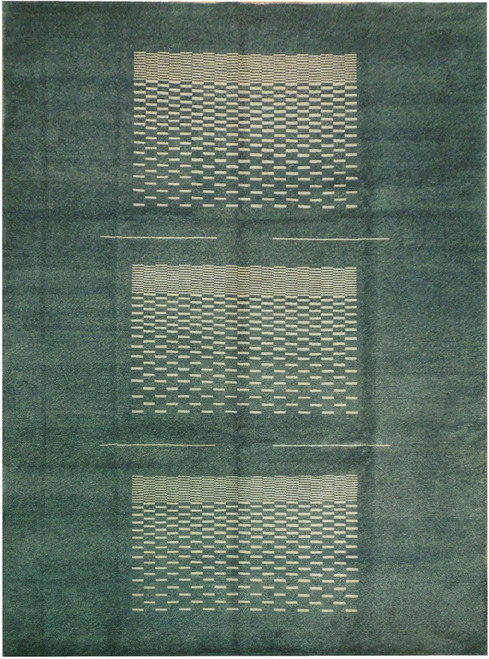
A modern rug drops the grid. No medallion, no spandrels, no border: the field is one surface and whatever happens on it happens across the whole rug at once. The construction underneath is unchanged. These are knotted by hand, at the same densities and in the same wools as the classical pieces, and a rug is no less hand-knotted for looking like nothing older than yesterday.
What has actually been taken away
The border is the part that matters. A border frames a rug and turns it into an object sitting on a floor, with an inside and an outside. Remove it and the rug reads as floor: the colour runs to the edge and stops there because the weaving stopped, not because a frame closed it. The second removal is direction. A classical field usually has a top, because vases stand up and medallions have pendants at each end. Most modern fields have none, so the rug can be turned end for end when one half has taken more light or more traffic. That is a real practical advantage and almost nobody mentions it.
Knotted around a rod
The usual construction here is Tibetan, which is not strictly knotting at all. A continuous yarn is looped around the warps and over a metal rod laid across the loom, a row at a time, and the loops are then cut along the rod to release the pile. Because the yarn runs continuously, density is quoted in lines per inch rather than knots per square inch. It produces a pile that stands upright and a slightly springy handle, and it handles a change of yarn mid-row easily, which is why it suits large plain fields and gradients better than fine drawing does. Very little of it is woven in Tibet now: the craft moved with Tibetan communities to Nepal, and a great deal is woven in India. The Tibetan and Nepalese pages cover the technique properly.
A plain field is the hard one
People assume a rug without a pattern is easier to weave. The opposite is true, because a pattern hides things and a plain ground hides nothing. Every dye lot join shows as a band across the full width. Any unevenness in the hand-spun yarn shows. So does the pile direction: run a hand one way and the field is dark, run it the other and it is pale, and on a solid colour that reads as watermarking or as pooled patches that some buyers return rugs over. None of it is a fault, and all of it is more visible on a single colour than on anything else in this catalogue. If an entirely even surface is the requirement, a hand-knotted rug is the wrong purchase.
Fibre doing the work pattern used to do
With the drawing gone, texture carries the rug. The common devices are a mixed pile that sets wool against silk so that the silk areas lie flat and shine while the wool stands up and absorbs, a field in bamboo silk for a high sheen at lower cost, and cut and loop construction where some rows are left uncut so the pattern is entirely a matter of height. Wool and silk blends are the most common of these. Check which fibre sits where before choosing a position, because the two wear at very different rates and a silk passage in a walking line will go first.
Old precedent for a plain field
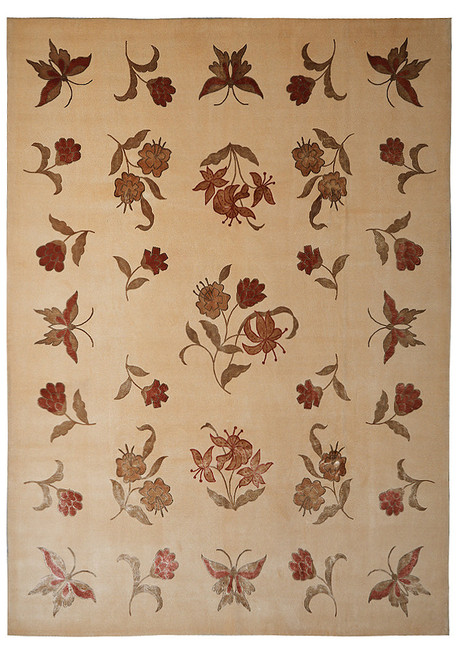
The idea is not a twentieth century invention. The Gabbeh is a plain or near-plain field with a few figures dropped into it, woven by the same households that made everything in the tribal group, and it predates modern design by a long way. A flat weave in blocks of colour does something similar without any pile. If the appeal of a modern rug is the quiet field rather than the styling, both are worth putting beside it.
Where a plain rug will disappoint
Under a dining table, in a hallway and in any room with a door to the garden. A pattern absorbs crumbs, grit and a dropped glass of red wine; a pale grey or ivory field displays each of them and holds the memory of the route people take across it. The honest advice is to put the plain rug where the traffic is not, and to accept a pattern where it is: a dense all-over traditional field, or a transitional piece if the room cannot take that much drawing. Where a modern rug is unbeatable is a room full of pattern and old furniture that needs one large calm surface on the floor, and it is the family that reaches 12x18 formats most easily, since there is no repeat to keep in register across ten metres of weaving.