Pakistani Rugs
Pakistan weaves two very different things under one name. One is the Bokhara, a dense repeat of octagonal guls on red, woven since Turkmen weavers settled here and about as traditional as a rug gets. The other is the vegetable-dyed revival: soft, open, pale carpets built to look a hundred years old on the day they are finished.
The Bokhara, and the gul
The Bokhara takes its field from Turkmen weaving: rows of the gul, an octagonal or lozenge-shaped device, repeated across a dark red ground at a strict interval. Turkmen tribes carried the design south and it settled around Lahore. The best examples are woven at a high knot count with a very short pile, which is what makes the repeat read crisply instead of blurring.
The double knot
Pakistani weaving is known for the double knot, tied so each pair of warps carries twice the yarn. The result is a very dense, very hard-wearing pile with a slightly stiffer handle than a comparable Persian rug. It is a construction built for use, and it is the reason a Bokhara survives a hallway that would flatten a finer piece.
Chobi and Ziegler
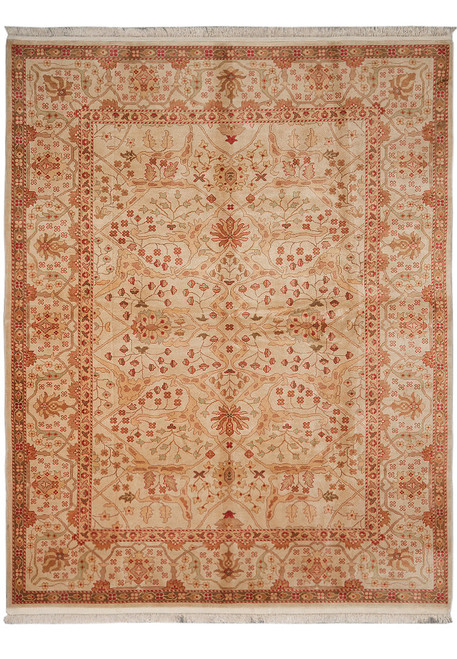
The second tradition is centred on Peshawar. Chobi means woodenwear in Urdu, after the plant dyes, and the palette is deliberately narrow: soft golds, browns, greys and faded blues. The Ziegler takes the same approach to a nineteenth-century commercial design, opening the field out and dropping most of the colours. Both are washed after weaving to take the newness off the wool.
On the washing
Every rug in this family is washed, and how far is the whole question. A light wash settles the colours and gives the wool its sheen. A heavy one strips the pile and leaves the wool dry and brittle. Run a hand across the field: it should feel springy rather than papery, and the colour at the base of the knot should not be dramatically stronger than at the tip.
Colour and room
A Bokhara is a red rug and will dominate a pale room, which in a study or a library is exactly what is wanted. A Chobi does the opposite and sits behind everything else in the room; it is the safest hand-knotted rug to put into an interior that already has pattern. The colour families set out what each ground does to a space, and the brown and ivory pages hold most of the revival weaves.
Where it belongs
Both traditions are wool and both take traffic well, so a hall or a dining room is fair. If you want the same geometric logic with more air in it, look at the Kazak; if you want the opposite, a curved workshop field, look at India.